Fort Jesus Museum, Portuguese coastal fort in Mombasa, Kenya
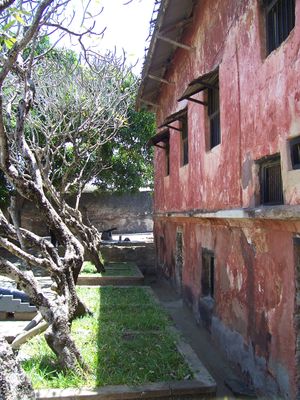
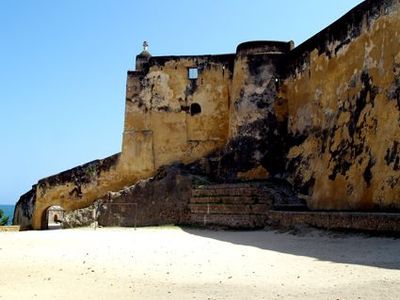
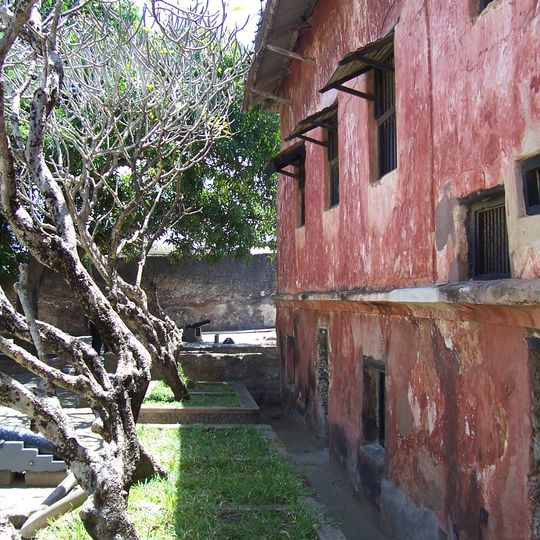
Fort Jesus Museum is a Portuguese fort on Mombasa Island, built from 1593 to 1596 to a design by Giovanni Battista Cairati. Its roughly square plan has four corner bulwarks, and the walls rise 18 metres, three of them added by the Omanis. Visitors see weathered reddish plaster over masonry, shuttered windows with wooden canopies, and a massive stone wall with a rounded bastion and a stepped buttress.
Designed by the Milanese architect Giovanni Battista Cairati and built between 1593 and 1596 under King Felipe II of Spain, Fort Jesus guarded the Old Port of Mombasa. The Portuguese lost it in 1631 to Sultan Yusuf ibn al-Hasan, retook it in 1632, and surrendered it in 1698 after a two-year siege by Omani forces under Saif bin Sultan. The British took over in 1895 and used it as a prison until 1958.
Omani rulers left Quranic inscriptions on the wooden door posts and ceiling beams, and a former meeting hall is supported by five stone pillars, one for each of the five pillars of Islam. The Portuguese and British presence survives in their cannons: Portuguese guns had a range of 200 metres, British guns 300.
The fort stands on Mombasa Island facing the old harbor entrance. The 18-meter walls and open courtyards offer little shade, so carry water and sun protection. A 76-foot well sunk by the Arabs is too salty for drinking, only for washing. The museum, conservation lab and Old Town Conservation Office are inside.
The fort's outline is said to resemble a person lying on their back, head toward the sea. The Portuguese walls stood 15 meters high; the Omanis added 3 meters after taking the fort in 1698, bringing them to 18 meters.
The community of curious travelers
AroundUs brings together thousands of curated places, local tips, and hidden gems, enriched daily by 93,141 contributors worldwide.