Arltunga Historical Reserve, Historic site and nature reserve in the Central Desert Region, Northern Territory, Australia
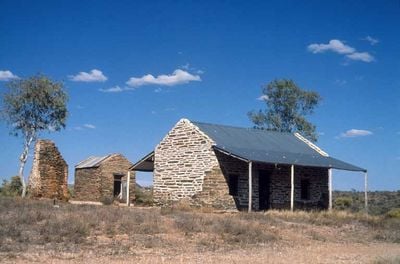
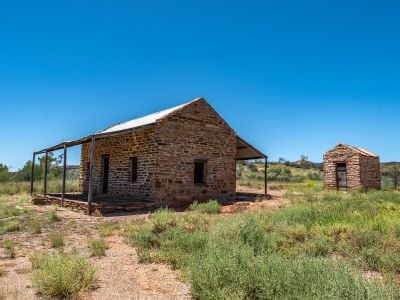
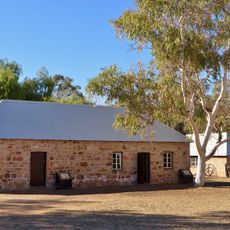
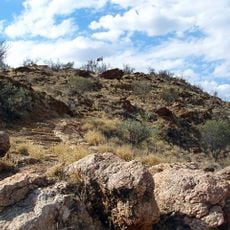
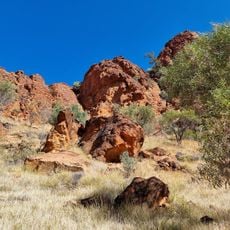
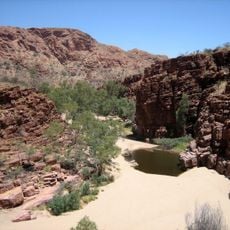
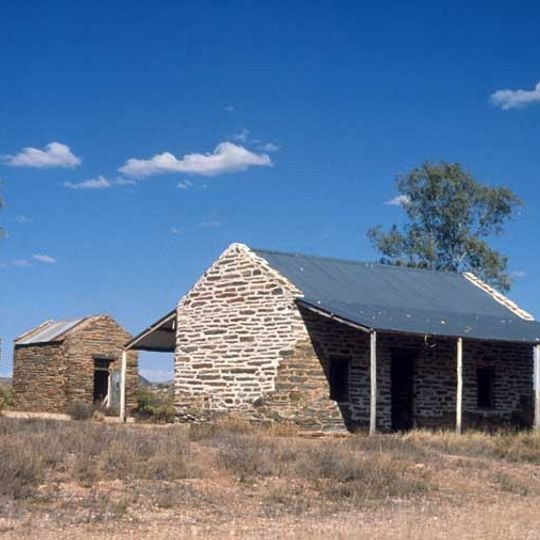
Arltunga Historical Reserve is a protected landscape and historic site in the Central Desert Region of the Northern Territory, about 110 km (68 mi) east of Alice Springs in the East MacDonnell Ranges. Its stone ruins include a single-storey building with a gabled roof, pale flat stones laid in rough courses with mud mortar, and a dark grey sheet roof extending over the front as an awning on thin metal posts. The reserve also holds mine shafts, the Government Battery and Cyanide Works, a police station and a cemetery.
Gold was first observed at Arltunga in 1887 by explorer David Lindsay, in creek sands below Paddy's Rockhole, and miners soon flocked to what became the first substantial European settlement in Central Australia. The South Australian Government built the Government Battery and Cyanide Works in 1898, supervised by James Gilbert Woolcock, and the police station followed in 1899. Drought in the 1890s dried up wells and starved the horses needed to cart ore; the population was 350 to 400 at the turn of the century but had fallen to 25 by 1933 as miners left for The Granites and Tennant Creek. The Little Flower Mission moved to the largely abandoned town in 1944 and left for Phillipson's Block in 1953.
The reserve is open every day and the access road is partly sealed and partly gravel, which is generally passable in a regular car during dry conditions. There are no shops on site, so visitors should bring enough water, food, and sun protection, especially in warmer months.
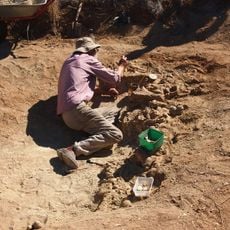
Rumors spread that old timber buildings were torn down because gold was hidden in the walls, but they were actually demolished simply because the wood was needed elsewhere. Just outside the reserve boundary, at a spot called Paddy's Rockhole, visitors can still try fossicking for gold with the right permit.
The community of curious travelers
AroundUs brings together thousands of curated places, local tips, and hidden gems, enriched daily by 94,701 contributors worldwide.