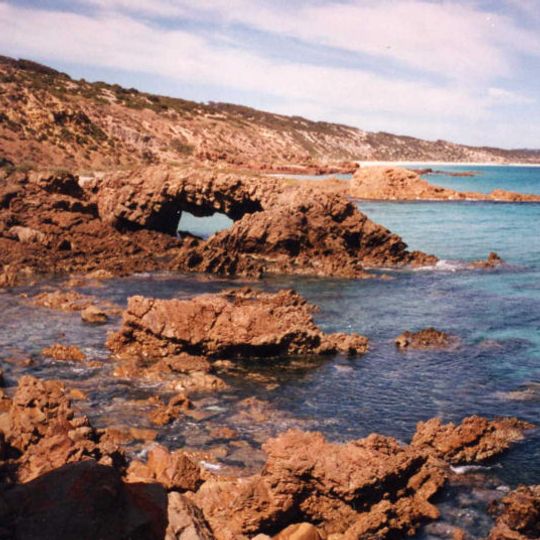
Emu Bay Shale, Fossil formation in Emu Bay, Kangaroo Island, Australia
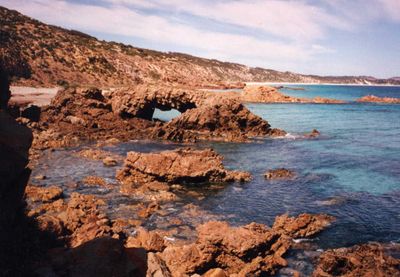
The Emu Bay Shale is a Cambrian fossil-bearing formation on the north coast of Kangaroo Island, South Australia, dated to about 514 million years ago. Its type section crops out on the east side of Emu Bay, where it overlies the White Point Conglomerate; the Big Gully locality, 8 km east of White Point, yields soft-bodied fossils. The rock is a Burgess Shale-type Konservat-Lagerstätte, Australia's only known example.
The Emu Bay Shale is dated to Cambrian Series 2, Stage 4, roughly 514 million years ago, correlated with the upper Botomian of the Lower Cambrian. Its type section crops out on the east side of Emu Bay, where it overlies the White Point Conglomerate; the Big Gully locality, 8 km east of White Point, yields the soft-bodied fossils. In 2011 seven large compound eyes were described from an inland quarry there.
The Emu Bay Shale is the only Burgess Shale-type Lagerstätte known in Australia, and its fossils are compared with the Chengjiang Biota of China, the closest assemblage palaeogeographically though somewhat older. Genera such as Squamacula, Kangacaris and the megacheiran Tanglangia are known only from these two sites. The trilobite genera Balcoracania and Emuella, with their many thoracic segments, are restricted to Australia and Antarctica.
The type section crops out on the east side of Emu Bay, where the shale overlies the White Point Conglomerate; the fossil-rich Big Gully locality lies 8 km east of White Point, with a quarry inland of the shoreline exposure. The terrain is coastal and unmarked, so a guide is needed to find the beds.
Some fossils found here contain preserved muscle tissue from nearly 520 million years ago, turned into minerals over time. This is extremely rare because soft tissue almost never survives the fossilization process.
The community of curious travelers
AroundUs brings together thousands of curated places, local tips, and hidden gems, enriched daily by 93,394 contributors worldwide.