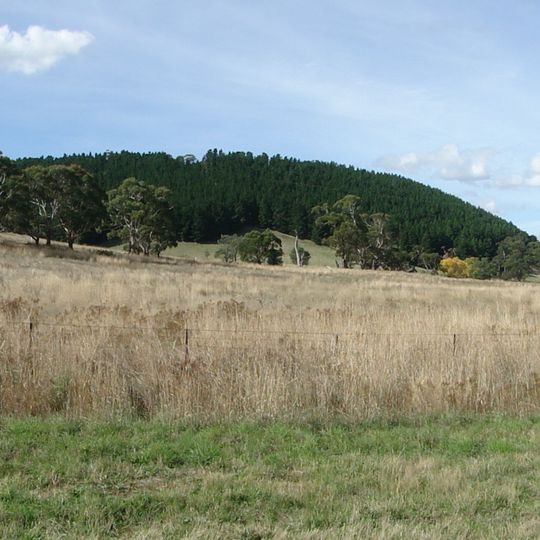
Mount Franklin, Extinct volcano in Victoria, Australia
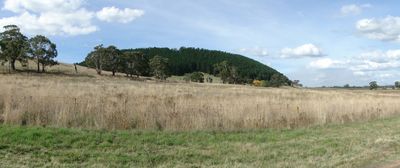
Mount Franklin is an extinct volcano in Victoria that rises approximately 650 meters above sea level and features a distinct crater depression. The slopes are forested with pine trees, and a sealed road circles the mountain, making it accessible for exploration.
The mountain was named by Charles Joseph La Trobe, superintendent of the Port Phillip District, after Sir John Franklin, whom he had climbed the hill with in December 1843. The volcano itself erupted about 470,000 years ago. In 1866 the crater became a recreation reserve, and after a 1944 bushfire the slopes were planted with conifers.
The Gunangara Gundidj clan called the mountain Willambeparamal, meaning "home of the emus". Ethnographic and archaeological evidence shows large ceremonial gatherings took place around it, and the Dja Dja Wurrung called the wider country the "smoking grounds".
A sealed road spirals up the outer slopes into the 50-acre caldera, where a central lawn is ringed by campsites with picnic tables and wood-fire barbecues; there is space for tents, caravans and RVs. A toilet block and a non-potable water tank stand near the entrance. The rim holds a fire lookout, parking area and picnic ground.
The coarse ejecta around the summit contains megacrysts of orthoclase up to 7 cm long and augite over 9 cm long, among the largest known in Victoria. Lumps of Ordovician sedimentary and granitic bedrock also occur in the ejecta, and small basalt blocks contain cores of crazed quartz.
The community of curious travelers
AroundUs brings together thousands of curated places, local tips, and hidden gems, enriched daily by 94,754 contributors worldwide.