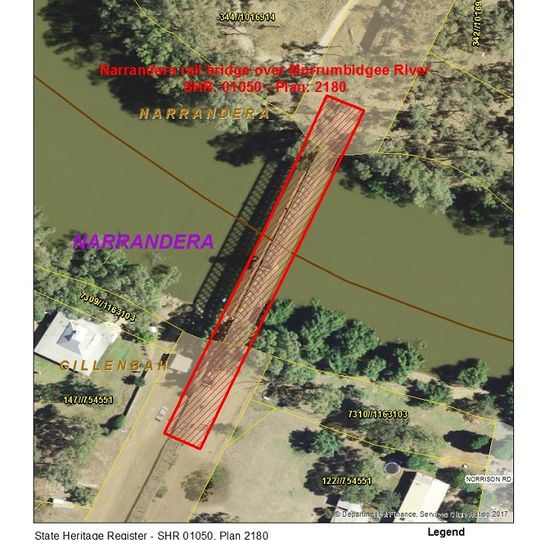
Murrumbidgee River railway bridge, Narrandera, Heritage railway bridge in Narrandera, Australia
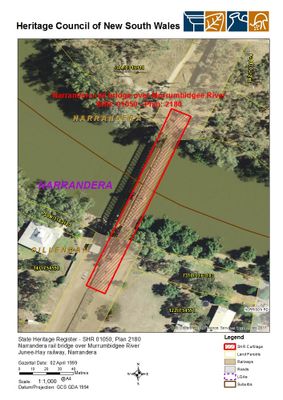
The Murrumbidgee River railway bridge is a two-span continuous wrought iron lattice truss bridge, with each span measuring 48.5 metres (159 ft) between pier centres. The lattice work has four triangulations, and the trusses are connected above the track by arched latticed braces. The bridge rests on twin cast iron cylinder piers supplied by the Stockton Forge Co. of England, and it carries a single standard gauge railway.
Engineer John Whitton designed the bridge in 1884, with Halliday & Owen constructing it using ironwork from the English firm Westwood Baillie. It operated as part of the Tocumwal railway line until the line closed in 1988.
The bridge linked rural communities to larger towns, carrying people and goods for decades and shaping how settlements developed along the rail corridor. It represents how railways once served as the lifeblood of regional transport in New South Wales.
Access to the bridge is restricted as it no longer operates as part of the rail network, but the structure remains visible from the surrounding area. Daytime visits offer better views to examine the iron lattice work and understand the engineering details.
The bridge demonstrates the shift from locally sourced timber to imported cast iron in Australian railway construction during the 1880s. This change in materials reflects how Australian engineering became increasingly shaped by British industrial methods and expertise.
The community of curious travelers
AroundUs brings together thousands of curated places, local tips, and hidden gems, enriched daily by 93,786 contributors worldwide.