Otago Museum, Cultural museum in Dunedin City, New Zealand.
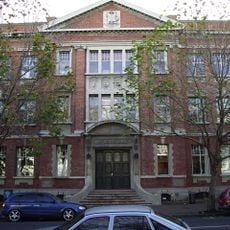
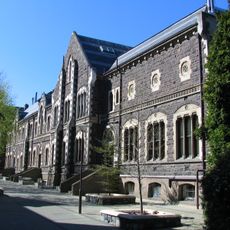
Otago Museum occupies a historic building on Great King Street whose original entrance, framed by Oamaru stone Doric-style pillars, still faces the street, while the main entrance now opens from the Museum Reserve. The 1877 building by architect David Ross was extended by the Hocken Wing (1910), the Willi Fels Wing (1930) and the Centennial Wing (1963), and a central Atrium added in the 1990s–2000s links the wings. The white facade carries a triangular pediment inscribed "OTAGO MUSEUM" above four fluted columns and a recessed double door.
James Hector first used the name "Otago Museum" for his geological collections shown at the 1865 New Zealand Exhibition in Dunedin. Some of these specimens formed the nucleus of the museum, which opened to the public on 12 September 1868 in the Dunedin Exchange building on Princes Street. The foundation of the present Great King Street building was laid in December 1874, and it opened in August 1877, designed by architect David Ross.
The galleries display indigenous artifacts and traditional objects that convey Māori heritage and its place in the region. Visitors can understand how this collection connects to the community's identity today.
The main entrance is on the Museum Reserve side, not the original Great King Street portico with its Oamaru stone Doric columns. Inside, the 1990s–2000s Atrium links the wings that were added in 1910, 1930 and 1963, so allow time to orient yourself between galleries.
Two of the three complete moa eggs known worldwide are held here: the Ettrick Egg and the First Earnscleugh Egg. The museum also keeps some 150 cuneiform tablets and inscriptions, the largest collection of its kind in the southern hemisphere.
The community of curious travelers
AroundUs brings together thousands of curated places, local tips, and hidden gems, enriched daily by 93,410 contributors worldwide.