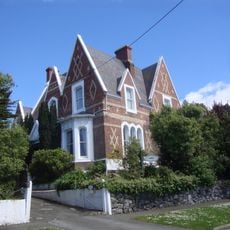
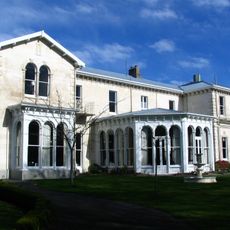
Cargill's Castle, Victorian mansion on coastal promontory in Dunedin, New Zealand.
Cargill's Castle is a Victorian-era mansion built from concrete and stone, standing on elevated coastal grounds overlooking the Pacific Ocean. The structure features detailed stonework and architectural elements typical of its period, positioned prominently on a promontory above the shoreline.
The mansion was built in 1877 for Edward Cargill, son of Dunedin's founder, initially known as The Cliffs. Architect Francis Petre designed it as an early example of concrete construction in New Zealand.
Edward Cargill named the house The Cliffs, and it was in its principal salon that Francis Petre married Cargill's daughter Margaret on 1 March 1881, after a courtship slowed by his Catholicism and the family's Presbyterianism. From the 1930s John Hutton ran it as a restaurant and cabaret, popular with servicemen during World War II.
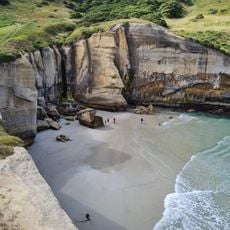
There is no public access to the ruin itself, so the site can only be viewed from outside. The castle stands on a promontory above the Pacific; Tunnel Beach, reached by a steep tunnel cut into the 60-metre cliffs, lies several kilometres to the south.
Tunnel Beach, several kilometres south of the castle, is reached only through a steeply sloping tunnel cut into the 60-metre cliffs by the Cargill family. Francis Petre, who designed the mansion, very likely supervised the tunnel's construction as well.
The community of curious travelers
AroundUs brings together thousands of curated places, local tips, and hidden gems, enriched daily by 93,774 contributors worldwide.