Dun Mountain, Mountain summit in the Richmond Range, Tasman District, New Zealand
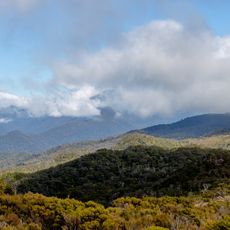
Dun Mountain is a summit in the Richmond Range between the Pelorus, Maitai and Roding Rivers, rising to 883 metres. Its upper slopes are brown, with stunted plant growth on soils high in heavy metals, and the colour comes from the ultramafic rock that forms the mountain.
The peak was first studied scientifically in 1859 by Ferdinand von Hochstetter, who identified a new rock type within it and named it dunite. This discovery established it as an important site for geological research.
The name comes from the mountain's brown, or dun, colour, caused by the ultramafic rock that forms it. That same rock stunts plant growth because of the soil's high heavy-metal content.
A mountain bike trail of roughly 38 kilometers starting from Nelson connects to the summit and covers varied terrain along the way. Visitors should prepare for changing conditions, especially on the exposed upper sections where weather can shift quickly.
Dun Mountain gave its name to dunite, the rock type first identified there in 1859. The mountain itself is a slab of Earth's mantle, part of the Dun Mountain Ophiolite Belt, formed in the Permian period and later pushed up into the Richmond Range.
The community of curious travelers
AroundUs brings together thousands of curated places, local tips, and hidden gems, enriched daily by 94,674 contributors worldwide.