Albert Park Volcano, Extinct volcanic cone in central Auckland, New Zealand.
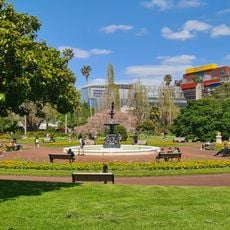
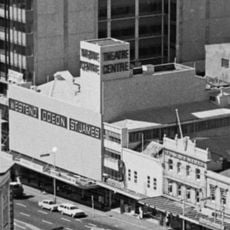
Albert Park Volcano is a small scoria cone of the Auckland volcanic field, most of whose surface rock was quarried away between 1840 and 1869. It erupted about 145,000 years ago, first spreading up to 8 metres of ash over the Queen Street Valley, then building a scoria mound with a short basalt lava flow from its western base. Reddish scoria deposits still cover the sandstone slope on the northern side of Albert Park, though the cone itself lay near the old courthouse, north-west of the park.
The volcano erupted an estimated 145,000 years ago, first with wet, explosive phases that laid up to 8 metres of ash across the Queen Street Valley, then with dry fountaining that built a small scoria mound. A lava flow from the western base ran down the valley, damming the Waihorotiu Stream and forming a swamp near where it met the Waitematā Harbour, an alluvial flat between Victoria and Wellesley Streets by today's Aotea Square.
The area north-west of Albert Park, called Rangipuke by Tāmaki Māori, was the site of a kāinga. The name and the settlement belong to the volcanic landscape that Hochstetter later mapped. A mānuka stump found in the 1870s, buried under ash and clay near the Albert Barracks, showed the ground was wooded before the eruption.
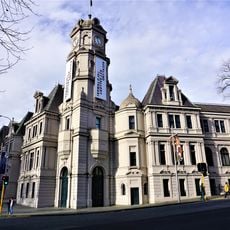
The cone itself lies buried near the old courthouse site on Victoria Street, north-west of Albert Park, not on the park's main lawn. Reddish scoria deposits still show on the park's northern slope above the sandstone. Look for them along the northern paths rather than expecting a crater.
Geologist Ferdinand von Hochstetter documented the volcanic nature of this place in 1859 during his visit to Auckland. His observations helped establish understanding of the area's geological story.
The community of curious travelers
AroundUs brings together thousands of curated places, local tips, and hidden gems, enriched daily by 94,350 contributors worldwide.