Auckland High Court, Gothic Revival courthouse in Auckland Region, New Zealand.
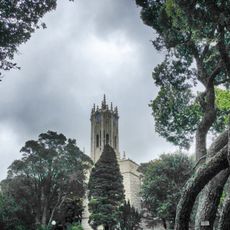
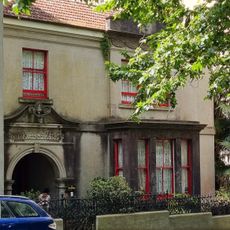
The Auckland High Court is a red brick Gothic Revival courthouse with a crenellated central tower and pointed-arch arcading. Its timber interior is also Gothic in style. Australian architect Edward Rumsey, a student of George Gilbert Scott, designed the building, which features gargoyles carved by Anton Teutenberg.
Construction began in 1865 but stalled when the original builder went bankrupt; Mathews and Bartley finished the red brick building in 1867 to Edward Rumsey's Gothic Revival design. Rumsey had studied under George Gilbert Scott. Originally called the Auckland Supreme Court, it was renamed in 1980, extended in 1935–36, and partly demolished in 1988 to enlarge the courthouse.
The two pōhutukawa trees behind the court mark the site of the General Assembly House, where New Zealand's Parliament sat while Auckland was the capital. Carvings by Anton Teutenberg over the central entrance show Queen Victoria and Prince Albert facing each other, among the country's first public sculptures.
The courthouse stands on Waterloo Quadrant, with the pōhutukawa trees marking the old General Assembly House site behind it. It remains a working High Court, so courtrooms are closed to casual visitors; the entranceway sculpture Waharoa and Fred Graham's Justice sculpture to the west can be seen from outside.
The two pōhutukawa trees behind the court mark where the General Assembly House stood, used by Parliament when Auckland was the capital. The gargoyles on the facade were carved by Prussian ship carpenter Anton Teutenberg and depict judges and dignitaries of the 1860s, including Queen Victoria and Hōne Heke.
The community of curious travelers
AroundUs brings together thousands of curated places, local tips, and hidden gems, enriched daily by 93,482 contributors worldwide.