Pōhutu Geyser, Geothermal geyser in Whakarewarewa Valley, New Zealand
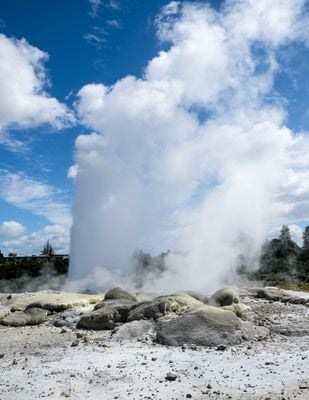
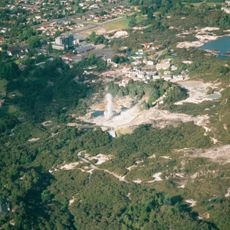
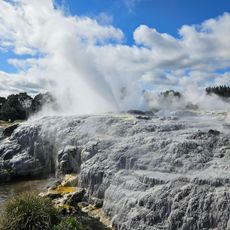
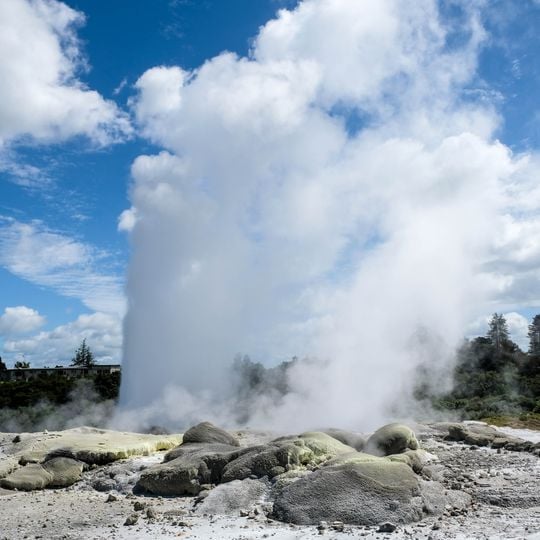
Pōhutu Geyser is a geyser in the Whakarewarewa Thermal Valley, Rotorua, on New Zealand's North Island. It erupts up to twenty times a day, throwing a column of water and steam as high as 30 m from a crater 50 cm in diameter. Its vent sits in a mound of grey, bulbous rock patched with pale yellow and green mineral deposits.
The geyser became known in the 1800s and attracted early visitors fascinated by its powerful eruptions. The valley has remained an active geothermal site studied by researchers over many decades.
The name Pōhutu comes from te reo Māori, though its etymology is uncertain: it is translated as 'big splash', 'explosion' or 'constant splashing'. The geyser sits in the Whakarewarewa Thermal Valley, where it erupts up to twenty times a day to heights of up to 30 m.
Pōhutu erupts up to twenty times a day, reaching heights of up to 30 m, so timing a visit around an eruption is worthwhile. The crater itself is only 50 cm across, and the surrounding ground is bare grey and white rock scattered with darker stones. Keep back from the vent: the water is boiling and the steam drifts low across the mound.
The crater of Pōhutu Geyser measures only about 50 cm across, yet it feeds eruptions reaching 30 m. After geothermal bores within 1.5 km were shut in the late 1980s, activity rose sharply; some scientists warn this regularity could one day exhaust the system.
The community of curious travelers
AroundUs brings together thousands of curated places, local tips, and hidden gems, enriched daily by 93,502 contributors worldwide.