Laie Hawaii Temple, Mormon temple in Laie, United States
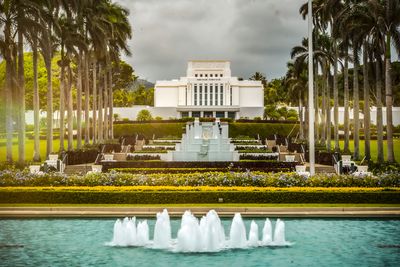
Laie Hawaii Temple is a white, symmetrical building at the end of a long reflecting pool, with a stepped central block, a row of tall narrow columns across the middle level, and lower flat-roofed wings. It sits on an 11-acre site on a small hill in Lāʻie, half a mile from the Pacific. The structure is built of crushed lava rock and reinforced concrete, and its white finish was made with pneumatic stone-cutting techniques.
Joseph F. Smith proposed a temple in Lāʻie at a meeting on February 15, 1885, and in 1915 announced plans for the first LDS temple outside the contiguous United States. Construction began in February 1916 using crushed lava rock and reinforced concrete; Heber J. Grant dedicated the completed building on November 27, 1919. After expansion from 10,500 to over 47,000 square feet, Spencer W. Kimball rededicated it on June 13, 1978, and Thomas S. Monson did so again on November 21, 2010, after seismic upgrades.
The temple is one of three institutions, with Brigham Young University–Hawaii and the Polynesian Cultural Center, that shape Lāʻie. Its Visitors' Center draws more than 100,000 people a year. After the 1919 dedication, Polynesian converts moved to Lāʻie to take part in temple ordinances, and guidebooks of the time compared the temple to the Taj Mahal.
Only members with an active recommend may enter the dedicated temple; other visitors can tour the grounds and the Visitors' Center, which holds a cut-away model of the interior. The center is open to the public and draws over 100,000 people a year. The temple stands on a small hill half a mile from the Pacific, 35 miles from Honolulu.
The temple has no spire, one of only four LDS temples without one, alongside Cardston Alberta, Paris France and Mesa Arizona. Its footprint forms a cross when seen from the air, and the highest point reaches 50 feet (15.2 m).
The community of curious travelers
AroundUs brings together thousands of curated places, local tips, and hidden gems, enriched daily by 93,022 contributors worldwide.