Polynesian Cultural Center, Cultural heritage attraction in Laie, United States.
The Polynesian Cultural Center is a 42-acre living museum in Lāʻie, Oʻahu, with eight simulated villages along a lagoon representing Hawaii, Tonga, Samoa, Aotearoa, Fiji, Tahiti, the Marquesas and Rapa Nui. A long low sign of light irregular stones carries brown uppercase letters and a fan-shaped emblem above a white band, with a small conical thatched roof behind it.
The center grew out of 1940s and 1950s hukilau and luau fundraising gatherings held to rebuild a fire-destroyed LDS chapel in Laie. In early 1962 church president David O. McKay authorized a nonprofit center for BYU-Hawaii student jobs and scholarships. Over 100 volunteer labor missionaries built 39 original buildings on former taro land using materials imported from the South Pacific; it opened in October 1963 at a material cost of $1.5 million.
The center displays traditions from Hawaii, Tahiti, Fiji, Samoa, and Tonga through crafts, music, and ceremonies that visitors experience firsthand. The different village areas convey everyday practices and artistic skills that run deep in these island cultures.
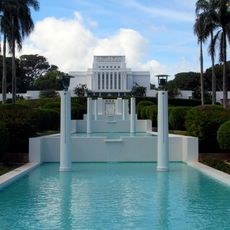
The center occupies 42 acres in Lāʻie, with the villages arranged along a central lagoon; a free shuttle also runs to the BYU–Hawaii campus and the Laie Hawaii Temple visitors' center. Canoe rides on the lagoon are available with a guide or by paddling yourself. The evening show and the luʻau cost extra beyond daytime admission.
The center hosts the annual World Fire Knife Dance Competition, where contestants wield blazing swords. Its roots lie in 1940s hukilau fishing festivals held to fund a chapel; "The Hukilau Song" was written after Jack Owens visited Lāʻie's hukilau.
The community of curious travelers
AroundUs brings together thousands of curated places, local tips, and hidden gems, enriched daily by 92,653 contributors worldwide.