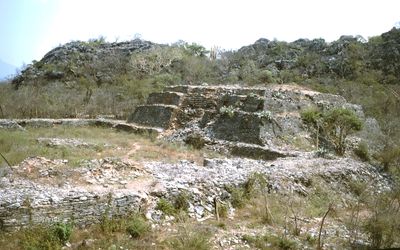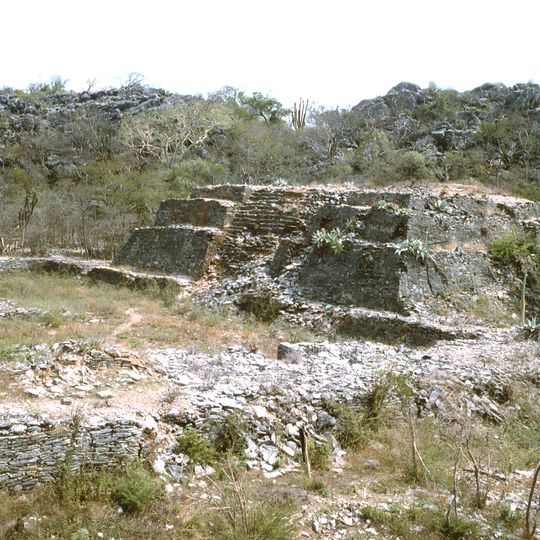
Guiengola, Archaeological site in Santo Domingo Tehuantepec, Mexico.
Guiengola is an archaeological site perched on a hilltop in Santo Domingo Tehuantepec with over 1,000 structures including pyramids, plazas, and residential buildings spread across a large area. The layout reveals the complexity of a fortified city with distinct zones for religious, administrative, and daily activities.
Guiengola is a Late Postclassic Zapotec settlement (roughly the 14th to early 16th century) above the Tehuantepec river system. Colonial documents describe it as a fortress tied to conflicts between Zapotecs and Mexica in the decades before the Spanish conquest. Surveys and airborne lidar between 2018 and 2023 showed a planned fortified city of about 360 hectares with more than 1,000 structures, including a walled defensive system and an internal road network.
The name Guiengola comes from Isthmus Zapotec guie, "stone", and ngola, "large" or "old"; the site is also called Danyroó, "large or old hill". The excavated tombs have a front chamber for religious idols and a rear chamber for burying important people, apparently family interments. The Zapotec call themselves binni záa, "people who come from the clouds".
Access requires driving on an unpaved road to reach the trailhead, followed by a steep climb with significant elevation gain. Visitors should bring sturdy footwear and plenty of water, as the hillside offers little shade during the hike.
Lidar scans conducted between 2018 and 2023 revealed artificial ponds and multiple ceremonial structures previously hidden beneath vegetation. These discoveries showed that the fortified city was far larger and more elaborate than previously understood.
The community of curious travelers
AroundUs brings together thousands of curated places, local tips, and hidden gems, enriched daily by 92,857 contributors worldwide.