Volcán Momotombito, Stratovolcano island in Lake Managua, Nicaragua
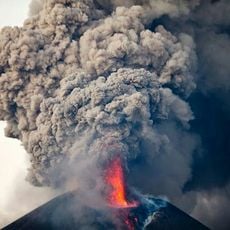
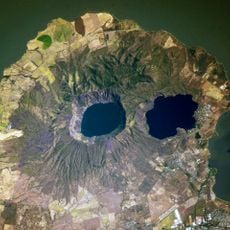
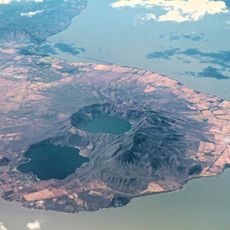
Momotombito is a stratovolcano forming the main island of Lake Managua (Xolotlán), in the western part of the lake south of the Momotombo volcanic complex. Its steep-sided cone rises about 350 metres above the water to a sharply pointed summit, with smooth flanks widening toward the shoreline. A lower landmass lies to its right along the horizon.
Momotombito is the main island of Lake Managua (Xolotlán), and the volcano that gives it its name is a stratovolcano about 350 m high, regarded as the younger brother of Momotombo on the mainland. The island was a pre-Columbian archaeological sanctuary called "Cocobolo" by the indigenous people because of the abundance of ñámbares trees. In 1850 the American explorer Ephraim Squier discovered and described several carved statues on its rocky slopes; large basalt idols of men and women were still buried there until the mid-20th century, when looters took them.
Indigenous people called the island Cocobolo, after the many ñámbar trees growing there, and used it as a pre-Columbian ceremonial site. In 1850 the American explorer Ephraim Squier found and described carved statues on its rocky slopes. Large basalt idols of men and women were still buried there until the mid-20th century, before looters took them.
Access requires coordination with local boat operators and navigation through the wetland areas surrounding the lake. Visitors should prepare for wet conditions and wear appropriate footwear and clothing for the environment.
The island was called Cocobolo by indigenous people for its abundance of ñámbares trees. In 1850 the American explorer Ephraim Squier found and described several carved statues on its rocky slopes; large basalt idols of men and women were still buried there until the mid-20th century, before looters took them.
The community of curious travelers
AroundUs brings together thousands of curated places, local tips, and hidden gems, enriched daily by 92,729 contributors worldwide.