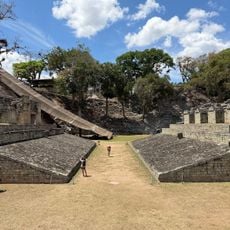
Copán, Maya archaeological site in Copán Ruinas, Honduras
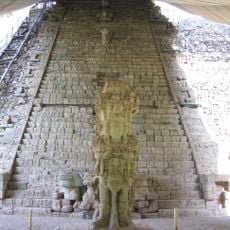
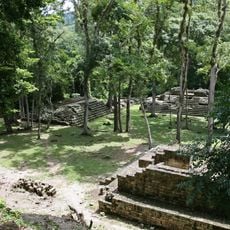
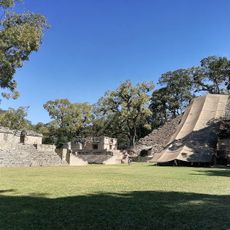
Copán is a Maya archaeological site in the Copán valley of western Honduras, near the Guatemalan border. Its core covers 0.6 square kilometres and includes a stepped stone structure with a wide tiered base of about eight steps, a raised platform with rectangular enclosures, and a tall carved stela showing a face with a layered headdress, ear ornaments, a crest above the head, and hands meeting at the chest.
Copán was occupied for over two thousand years, from the Early Preclassic to the Postclassic, and its first known stone architecture dates to about the 9th century BC. A new dynasty with origins at Tikal was founded in AD 426, and the city became a regional power in the southern Maya area. In 738 its long-ruling king Uaxaclajuun Ub'aah K'awiil was captured and beheaded by K'ak' Tiliw Chan Yopaat of Quiriguá, a former vassal; after a 17-year hiatus, rulers resumed building monuments within a few decades. The population fell from perhaps over 20,000 to under 5,000 in the 8th and 9th centuries, and the ceremonial centre was abandoned long before the Spanish arrived in the 16th century.
The name Copán is recorded from the 16th century and may derive from the Nahuatl word copantl, meaning "bridge." The ancient name was likely Oxwitik, which Linda Schele and Looper translated as "Three Roots." The site's emblem glyph reads kuhul Xukpí ajaw, so the city was also called Xukpí.
Walking through the main zone takes about three hours and involves uneven terrain with some steep sections. Visitors should wear comfortable shoes and bring water, as most of the route has little shade.
Beneath the main temple lies an older structure called Rosalila, discovered in 1989, which still shows traces of its original red paint from 571. These paint remains are exceptional for Maya archaeology, as organic pigments rarely survive centuries.
The community of curious travelers
AroundUs brings together thousands of curated places, local tips, and hidden gems, enriched daily by 92,691 contributors worldwide.