La Yeguada, Stratovolcano in central-west Panama.
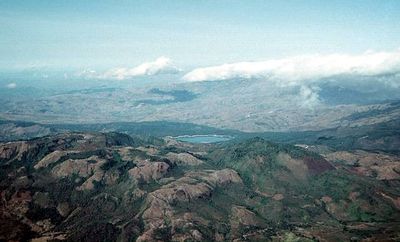
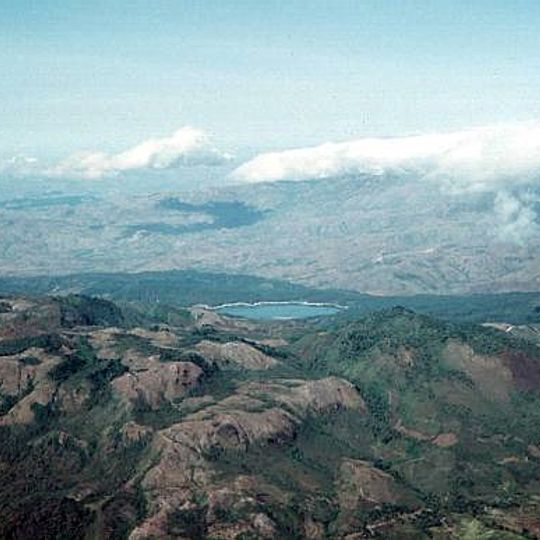
La Yeguada, also called Chitra-Calobre, is a massive stratovolcano in Veraguas Province, Panama, north of the Azuero Peninsula. Its broad, low mountain mass is covered in green vegetation, with darker forested patches and paler grassland. On the right of the ridge, a small irregular lake lies in a shallow basin, and a rocky brown-grey knob breaks through the green cover lower down.
De Boer and colleagues first established that La Yeguada is an active volcano and part of the Central American volcanic arc as it extends through Panama. Defant's team later used lava geochemistry to show the rocks are calc-alkaline, derived by subduction. Radiometric dating placed the volcanism in two groups spanning 20 million years to recent, the youngest consisting mainly of adakites and the older of normal calc-alkaline lavas.
Local communities around the volcano have adapted to living in this volcanic region and use the surrounding lands for farming and daily activities. People here have a natural understanding of the geological forces that shape their environment.
The best time to visit is during drier months when walking conditions are more favorable on the terrain. Proper footwear and careful orientation are essential since the slopes are steep and the ground can be uneven.
A smaller cone formation called Media Luna near the main volcano represents a more recent geological development in the area. This secondary feature provides clues about how volcanic systems continue to evolve after their primary phase ends.
The community of curious travelers
AroundUs brings together thousands of curated places, local tips, and hidden gems, enriched daily by 92,651 contributors worldwide.