Nevado del Huila, Active stratovolcano in Andes Mountains, Colombia.
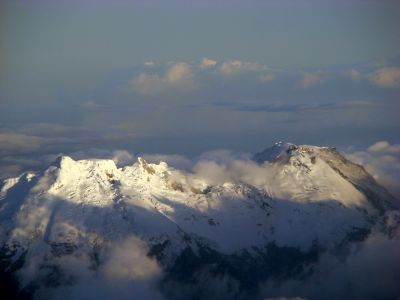
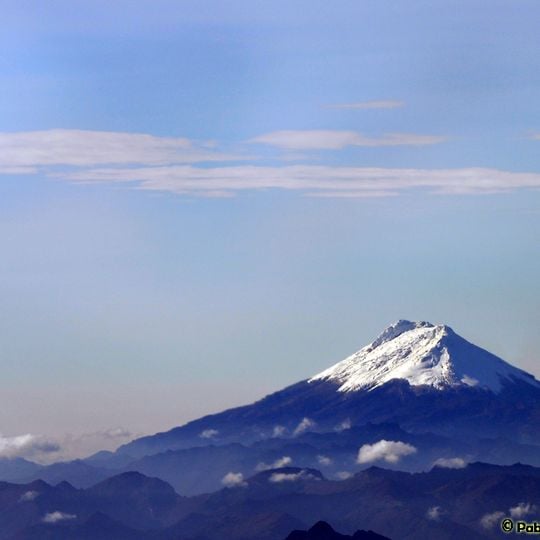
Nevado del Huila is an active andesitic stratovolcano at the tripoint of Huila, Tolima and Cauca departments, its summit reaching 5,364 m, the highest point of all three. Its upper part forms a steep, roughly conical peak where snow and ice lie in irregular patches and streaks over darker exposed rock, while the broad lower slopes fall away in muted blue-brown ridges. The massif carries several summits above 5,000 m, among them Pico Central, Pico Norte, La Cresta, the Domo and Pico Sur.
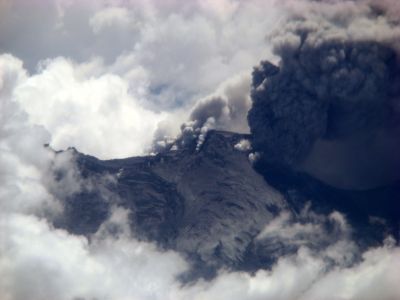
After more than 500 years dormant, Nevado del Huila erupted twice on 18 April 2007, sending lahars down the Páez River and forcing over 4,000 people to evacuate. Activity resumed in March 2008, and on 20 November 2008 an explosive eruption melted part of the ice cap, producing a mudflow up to 30 m high and a 400 m crater with a lava dome inside. Ten people died in that eruption; ash fell on 17 municipalities in October 2009.
The volcano stands in the Macizo Colombiano, a region the sources call one of the country's main water factories for its influence on several river basins. Eruptions since 2007 forced the evacuation of Indigenous and peasant communities, especially in the Tóez resguardo and other areas of Cauca department. Residents of Páez villages still recall the 1985 Nevado del Ruiz eruption and the Armero tragedy.
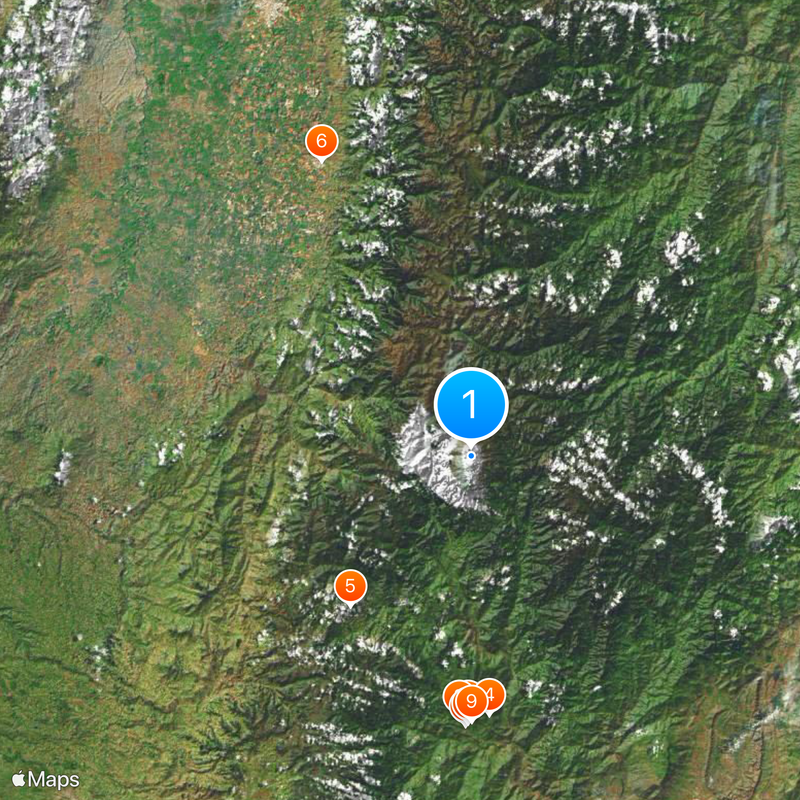
The summit lies at the tripoint of Huila, Tolima and Cauca departments, and the volcano is the central point of the Nevado del Huila National Natural Park. Its activity is monitored continuously by the Servicio Geológico Colombiano through the Observatorio Vulcanológico y Sismológico de Popayán, which tracks possible eruptions and lahars. Sudden glacial melt during eruptions can send mudflows down the Páez and Magdalena valleys, so check the alert level before approaching.
The summit is the highest point of three departments at once: Huila, Tolima and Cauca meet at the tripoint on the volcano. The 2008 explosive eruption opened a crater 400 metres across with a lava dome inside it, and the volcano is visible from the city of Cali on clear days.
The community of curious travelers
AroundUs brings together thousands of curated places, local tips, and hidden gems, enriched daily by 92,835 contributors worldwide.