Ex Convento y Templo de San Diego, Aguascalientes, Religious complex in Aguascalientes, Mexico
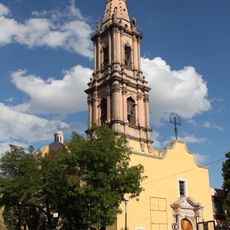
The Ex Convento y Templo de San Diego is a religious complex comprising the Temple of the Immaculate Conception, the Camarín de la Inmaculada, the Temple of the Third Order, the former convent, and catacombs. The Camarín, a chapel for changing the Virgin's garments, has a circular plan with a spherical dome on a drum, built 1792–1797. The convent was founded in 1664.
The Carmelite convent was founded in 1640 under the patronage of Agustín Rincón de Ortega, though sources differ on the friars' arrival. Carmelites served the temple around 1651, and the Dieguine Franciscans took over in 1664, completing the convent in the 18th century. On 15 January 1867 the convent became the School of Agriculture, predecessor of the Universidad Autónoma de Aguascalientes, founded there in 1973.
The interior walls display colonial paintings, including murals by Juan Correa depicting scenes from the life of Saint Francis of Assisi. These artworks reflect the religious devotion that shaped the spaces of this complex.
The complex faces the Parián and is bounded by Álvaro Obregón, Benito Juárez, Rivero y Gutiérrez and José Ma. Morelos streets. The Camarín, a chapel for changing the Virgin's vestments, is reached through the temple and is crowned by a large spherical dome on a drum. Its catacombs are divided into a section of niches with bone remains and ashes and a corridor of 17th- to 19th-century burials.
The catacombs occupy the Camarín de la Inmaculada, not the temple itself. They have two parts: crypts with niches holding bone remains and ashes from different periods, and a corridor with burials from the 17th to 19th centuries. In colonial times the dead were buried in consecrated ground, and here that ground was the Camarín.
The community of curious travelers
AroundUs brings together thousands of curated places, local tips, and hidden gems, enriched daily by 93,764 contributors worldwide.