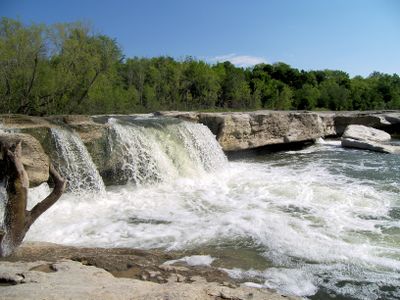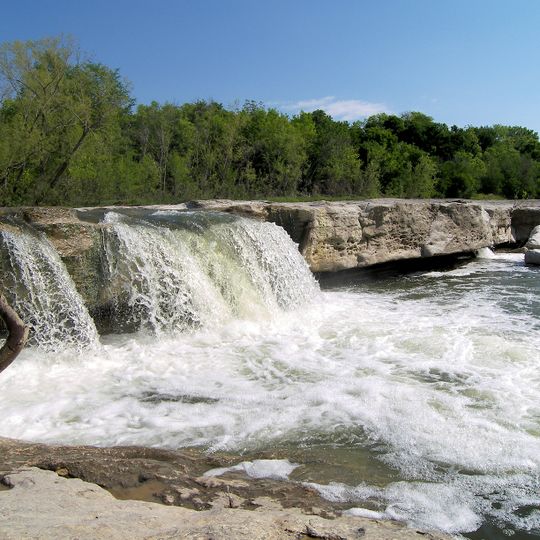
McKinney Falls State Park, State park with waterfalls in Austin, US.
McKinney Falls State Park is a 744.4-acre protected area at the confluence of Onion Creek and Williamson Creek in Austin. Onion Creek drops over two limestone ledges, the upper and lower falls, cut where softer volcanic ash eroded beneath the harder rock. Bald cypress, sycamore and pecan line the creek banks, while live oak, juniper and cactus grow on the drier uplands.
Thomas McKinney settled here in the 1850s and built mills powered by water and horses to grind grain for neighboring farms. Thousands of years earlier, Native communities used this area as a camp, and archaeological finds show they returned to this spot across many generations.
The park lies on the El Camino Real de los Tejas National Historic Trail; in 1716 Domingo Ramón's expedition followed Onion Creek's left bank along the park's western edge, and wear marks in the rock remain from that use. The Smith Rock Shelter, a limestone overhang used by Native Americans for hundreds of years, and the McKinney homestead are both on the National Register of Historic Places.
Visitors reach both waterfalls by short footpaths from the parking lot, with flat sections near the entrance accessible for wheelchairs. Water flow varies widely by season, so a visit after recent rains shows the falls at full strength, while dry spells leave only thin streams.
The limestone beneath the park holds fossils of extinct sea creatures such as Inoceramus and Exogyra, and a complete mosasaur skeleton was found in Onion Creek rocks nearby. The falls themselves formed as soft ash from the extinct Pilot Knob volcano eroded faster than the hard limestone, undercutting the ledges.
The community of curious travelers
AroundUs brings together thousands of curated places, local tips, and hidden gems, enriched daily by 92,842 contributors worldwide.