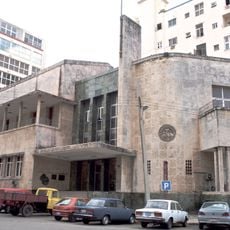
Napoleon Museum, Napoleonic museum on San Miguel Street, Vedado, Havana, Cuba
The Napoleon Museum is a museum housed in a Florentine Renaissance-style building in the Vedado neighborhood of Havana, Cuba. It holds one of the largest collections of objects from Napoleon's era outside of Europe, including furniture, uniforms, weapons, paintings, and personal items.
The mansion La Dolce Dimora was built in 1929 for the Italian-Cuban politician Orestes Ferrara, designed by architects Evelio Govantes and Félix Cabarrocas, who also worked on El Capitolio. The Napoleonic collection belonged to sugar magnate Julio Lobo, with items from Fulgencio Batista and businessman Óscar Cintas. After the 1959 revolution the state seized the holdings, and the museum opened on 1 December 1961. It reopened in March 2011 after a three-year restoration by the City Historian's Office.
The museum's name appears in gold lettering beside the arched entrance, whose wedge stones are carved with sunbursts and whose iron gates carry lion's-head medallions. Inside, the collection began with sugar magnate Julio Lobo's purchases in the first half of the 20th century, joined by items from Fulgencio Batista, an admirer of Napoleon who kept duelling pistols and a telescope at his Finca Cuquine residence.
The museum sits in the Vedado neighborhood, not far from the University of Havana, and is easy to reach on foot from many parts of the area. Most visitors move through the rooms in one to two hours, and guided tours in Spanish are available on site.
Among the objects is a death mask of Napoleon made by his physician Dr. Francesco Antommarchi shortly after Napoleon died in 1821 on Saint Helena. Antommarchi later moved to Cuba, which creates a direct personal link between this collection and the history of the island.
The community of curious travelers
AroundUs brings together thousands of curated places, local tips, and hidden gems, enriched daily by 92,865 contributors worldwide.