Puerta del Conde, Historic city gate in Santo Domingo, Dominican Republic.
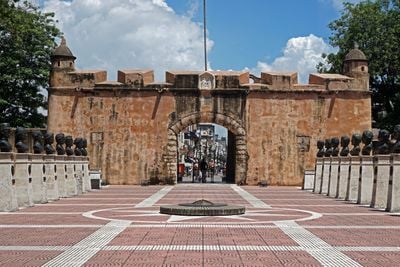
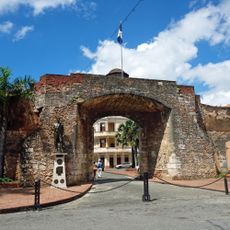
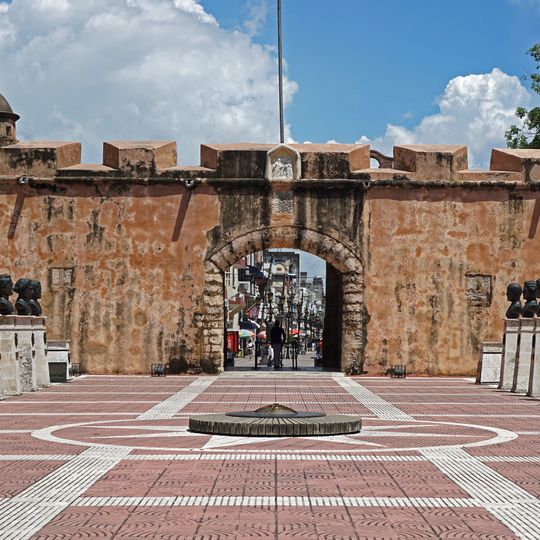
Puerta del Conde is a 17th-century military gate in Santo Domingo's Ciudad Colonial, formed by two solid stone cubes joined by a stone arch. The rough ochre and brown wall is topped with square crenellations, and above the arch a small carved emblem sits beneath a niche holding a figure. Dark busts on short pedestals flank the wall in the paved plaza in front.
Construction began in 1543 as Fort San Genaro, built to guard Santo Domingo from pirates and corsairs. After the English siege of 1655 under William Penn and Robert Venables was repelled by Captain-General Bernardino de Meneses Bracamonte y Zapata, Count of Peñalva, the wall was joined to the fort and the complex took his name. On February 27, 1844, Francisco del Rosario Sánchez proclaimed independence and raised the first Dominican flag here.
The gate's name honors Bernardino de Meneses Bracamonte y Zapata, Count of Peñalva, who defended the city in 1655. Each February 27, Dominicans mark Independence Day here, recalling Francisco del Rosario Sánchez raising the first flag in 1844. Above the arch, the Latin motto "Dulce et Decori est pro patria mori" is carved.
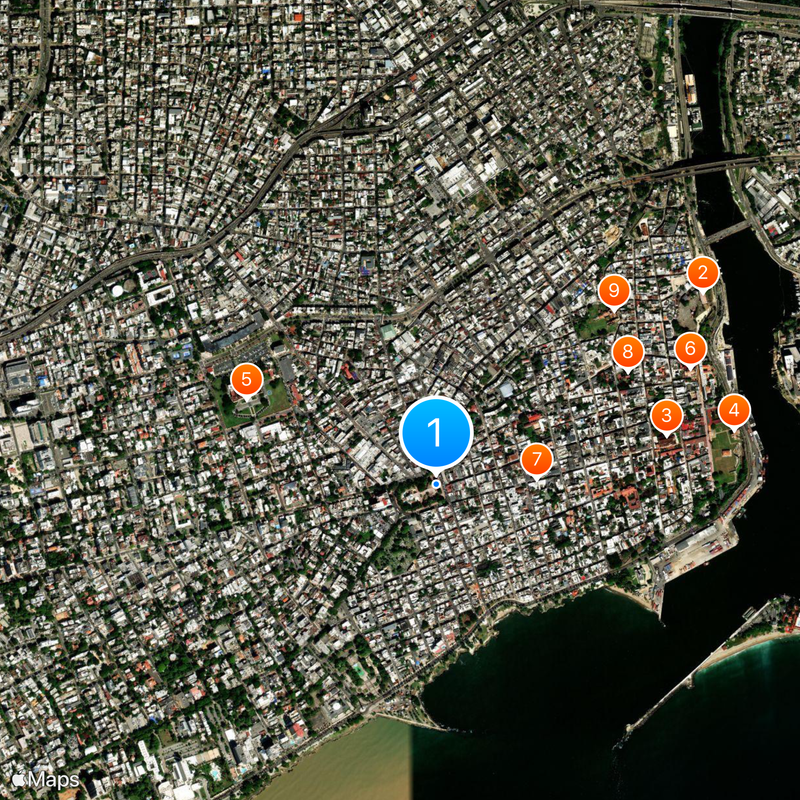
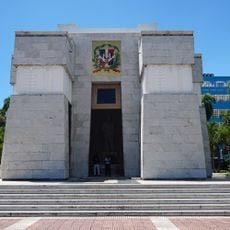
The gate stands at the western end of Calle El Conde, where it meets Independence Park; the park is the country's kilometre zero, marked by a bronze compass rose with 32 directions set into the pavement. The Altar de la Patria, a white marble mausoleum, is in the park's centre. The area is paved and level, with short pedestals holding busts in front of the wall.
Latin text is carved above the gate arch that translates to 'It is sweet and honorable to die for the fatherland.' This inscription from the colonial era reveals the philosophical ideals that motivated the city's early defenders.
The community of curious travelers
AroundUs brings together thousands of curated places, local tips, and hidden gems, enriched daily by 94,058 contributors worldwide.