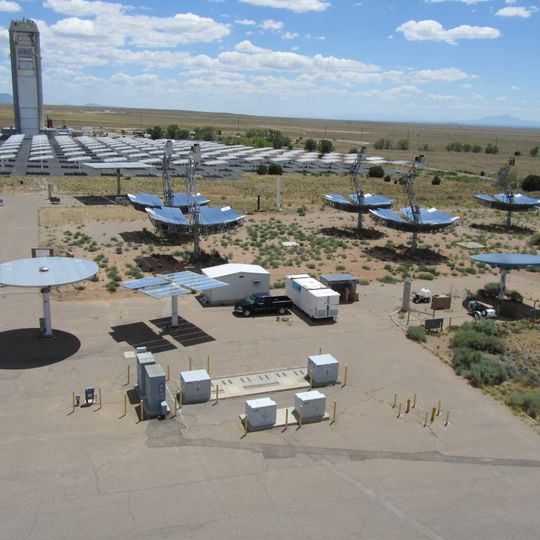
National Solar Thermal Test Facility, Research site in Albuquerque, New Mexico, US
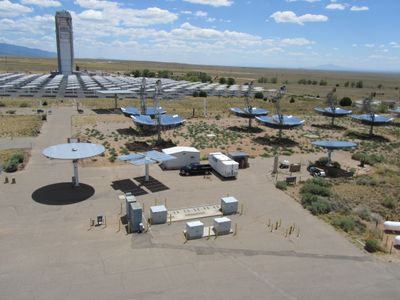
The National Solar Thermal Test Facility is a 47-hectare research site 10 km south of Albuquerque, New Mexico. Its field of 218 heliostats, each with 37 m² of reflective surface, directs sunlight onto a 61 m concrete tower with test stations on its north side and top. The site also includes a molten salt test loop and a dish test area with full-scale solar dishes.
In the late 1970s, rising fuel costs and demand for cleaner energy drove the United States to develop solar thermal power. Studies identified the central receiver concept as promising for large-scale electricity generation, and the National Science Foundation's RANN program began supporting the work in 1972, later funded by the Energy Research and Development Administration and the Department of Energy. Six central receiver pilot plants were built, including the 5 MW thermal test facility at Sandia National Laboratories.
The heliostats and receivers developed here were later installed at the Solar One and Solar Two power plants, both now dismantled. NASA still uses the site to test heat shields for spacecraft, and Boeing has also run tests here.
The facility is a working research site operated by Sandia National Laboratories for the U.S. Department of Energy, not a public attraction, so access is arranged through the operator rather than by casual visit. It lies about 10 km south of Albuquerque, New Mexico, on a 47-hectare site. The heliostat field, the 61 m concrete tower and the dish area are the main structures to look for from outside.
Each heliostat in the facility maintains 96 percent reflectivity across 37 square meters, directing concentrated sunlight toward experimental testing areas.
The community of curious travelers
AroundUs brings together thousands of curated places, local tips, and hidden gems, enriched daily by 93,766 contributors worldwide.