Cisco, Ghost town in Grand County, Utah
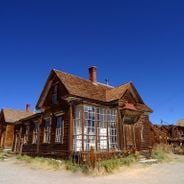
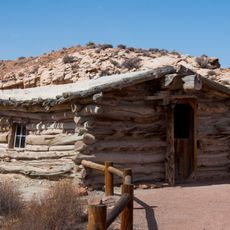
Cisco is a ghost town in Grand County, Utah, near the junction of State Route 128 and Interstate 70. Its site holds relics of an old west railroad town, including a low single-storey wooden building with a weathered grey-brown plank facade, a faded red band above a large plate-glass window painted with the words "OPEN" and "CLOSED", and a roof of uneven grey shingles rising to a stepped peak.
Cisco began shortly after 1880 as a supply point for the Denver and Rio Grande Western Railroad, not as a mining camp. Ranchers and herders from the Book Cliffs made it a provisioning center, and at times 100,000 sheep a year were sheared there before shipment by rail. Oil and natural gas were found nearby in 1924, but the town's decline, which had started with the end of steam locomotives, was completed when Interstate 70 bypassed it.
Cisco's name survives in popular culture: Johnny Cash wrote the song "Cisco Clifton's Fillin Station" about resident Harry Ballard Harris. Parts of Thelma & Louise (1991) and Don't Come Knocking (2005) were filmed here, and the town's Cisco Landing Store has operated intermittently in recent years.
Cisco sits at Exit 204 of Interstate 70, where it meets State Route 128; the old US-6/US-50 routing runs through the townsite. The Union Pacific siding is still in use, but the California Zephyr passes without stopping. Rafters finishing Westwater Canyon use Cisco Landing and Fish Ford, reached via County Highways 176 and 177 south of town, and the Kokopelli mountain bike trail crosses the site.
Cisco appears in the 1971 film Vanishing Point, in its opening and closing scenes. Parts of Thelma & Louise (1991) and Don't Come Knocking (2005) were also shot here and nearby. Johnny Cash wrote the song "Cisco Clifton's Fillin Station" about resident Harry Ballard Harris.
The community of curious travelers
AroundUs brings together thousands of curated places, local tips, and hidden gems, enriched daily by 93,780 contributors worldwide.