Wyoming State Capitol, State Capitol building in Cheyenne, United States
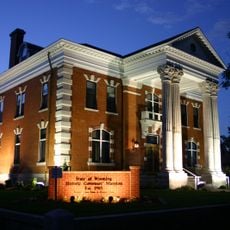
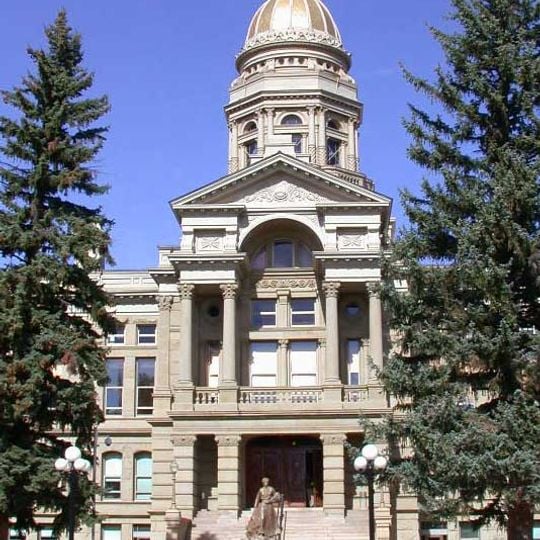
The Wyoming State Capitol is a Renaissance Revival government building in Cheyenne, about 90 m long and 25 to 34 m wide, with a portico and dome modelled on the Paris Invalides. Its dome peaks at 146 feet (44.5 m), and the roof alone reaches 18 m. The lower storeys use sandstone from Fort Collins, Colorado, the upper storeys grey sandstone from quarries near Rawlins, Wyoming.
Construction began on September 9, 1886, under a plan by David W. Gibbs & Company, with the cornerstone laid on May 18, 1887. The east and west wings were finished in 1890, the year Wyoming became a state. William DuBois designed the House and Senate chambers added in 1915–1917. The building became a National Historic Landmark in 1987.
The Capitol's name comes from the Wyoming Territory, organized in 1869 with Cheyenne as its seat. In the Senate and House chambers, eight murals painted by Allen Tupper True in August 1917 for $500 each show figures such as the Pony Express Rider, Railroad Builders, Cattlemen and Homesteaders. Visitors can view them from third-floor balconies.
The Capitol reopened to the public on July 10, 2019, after a three-year renovation. The front steps carry the State Seal in granite, and the third-floor balconies above both chambers are open to visitors. The 2016–2019 work added stairs, elevators and restrooms.
The dome was originally copper, but by 1900 it had tarnished so badly that it was gilded with gold leaf. It has been gilded five times, most recently in 2009, and that work extended its life expectancy from 15 years to 90. The 2016–2019 restoration also demolished a neighbouring building's atrium so the dome could be seen from North Capitol Avenue.
The community of curious travelers
AroundUs brings together thousands of curated places, local tips, and hidden gems, enriched daily by 94,087 contributors worldwide.