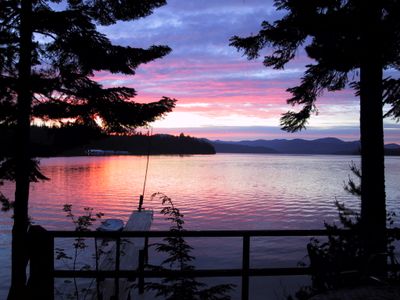
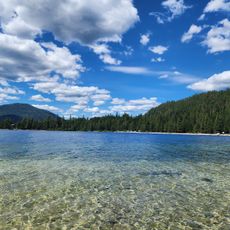
Priest Lake, Lake in northern Idaho, United States.
Priest Lake lies in the Selkirk Mountains of the Idaho Panhandle at 743 m elevation, 80 miles northeast of Spokane. The main body, lower Priest, runs 19 miles north-south and is over 300 feet deep; upper Priest connects through a 2.5-mile thoroughfare. Its surface covers 105 km², and a weir at the southern outlet has regulated the water level since 9 August 1950.
Around 10,000 years ago, as glaciers retreated at the end of the last ice age, people resettled the Priest Lake area, leaving artifacts and rock art along the shore. In the 1840s the Jesuit priest Pierre-Jean De Smet worked with the Kalispel tribe on the nearby Pend Oreille River and, using their information, mapped the lake as Roothaan Lake for a superior in Rome. In 1865 Captain John Mullan, building the Mullan Road from Walla Walla to Fort Benton, renamed it Kaniksu; it later became Priest Lake.
The Kalispel tribe supplied the information from which Jesuit priest Pierre-Jean De Smet drew his 1840s map of the lake, and he named it Roothaan Lake after a superior in Rome. That name did not last: in 1865 Captain John Mullan renamed it Kaniksu, and it was later called Priest Lake. Huckleberries grow around the lake, and visitors are encouraged to hike in and pick them.
The water connects with the Priest River system and offers year-round opportunities for fishing, boating, and water recreation, with several public access points along the shoreline available for visitors throughout different seasons.
The largest lake trout caught in the United States came from Priest Lake: Lyle McClure of Spokane landed a 57 lb 8 oz fish here in 1971. Average lake trout in the lake weigh between 4 and 10 pounds. Eurasian milfoil, an invasive aquatic plant, was found in the lake in 2006.
The community of curious travelers
AroundUs brings together thousands of curated places, local tips, and hidden gems, enriched daily by 93,794 contributors worldwide.