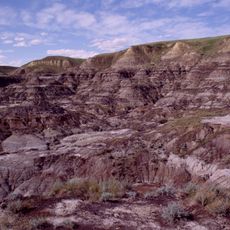
Horseshoe Canyon Formation, Geological formation in Drumheller, Alberta, Canada
The Horseshoe Canyon Formation is a Late Cretaceous stratigraphic unit of the Western Canada Sedimentary Basin, about 250 metres thick in its type section in the Red Deer River Valley at Drumheller. It consists of mudstone, sandstone, carbonaceous shales and coal seams, and appears as banded, eroded badland slopes of pale grey-white and darker grey-brown rock cut by vertical gullies.
The formation originated during the Late Cretaceous period roughly 70 million years ago, spanning the Campanian to early Maastrichtian stages. This era shaped the deposits that later became important for mining activity.
The Drumheller Coal Zone, in the lower part of the formation, was mined for sub-bituminous coal from 1911 to 1979. The Atlas Coal Mine near Drumheller, now a National Historic Site, keeps the equipment and structures of that industry. The formation's name comes from Horseshoe Canyon, a roughly 3 km badland gorge 17 km southwest of Drumheller on Highway 9, whose course bends like a horseshoe.
The formation is accessible through observation areas along nearby highways, with several points offering clear views of the geological layers. Wear appropriate footwear as the terrain is uneven and weather protection may be needed.
The formation's coal seams near Edmonton and Drumheller have yielded amber containing a varied arthropod fauna from the Late Cretaceous; plant fossils in the amber are extremely rare. The deposits also produced Albertonykus borealis, a chicken-sized alvarezsaurid and the smallest dinosaur known from North America.
The community of curious travelers
AroundUs brings together thousands of curated places, local tips, and hidden gems, enriched daily by 93,803 contributors worldwide.