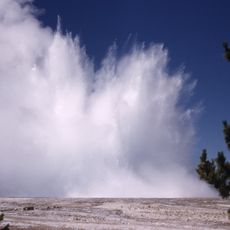
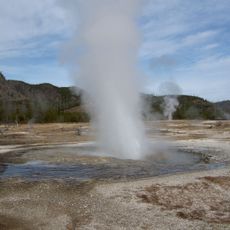
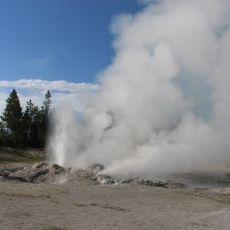
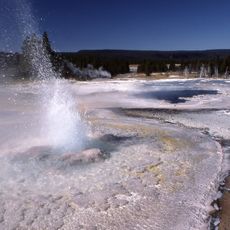
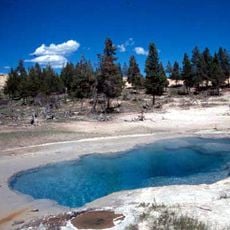
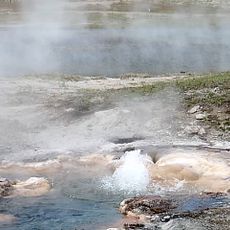
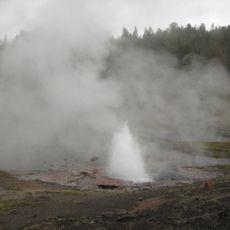
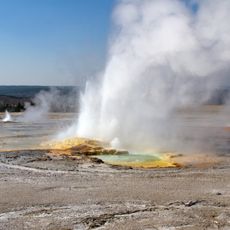
White Dome Geyser, Geyser in Yellowstone National Park, United States.
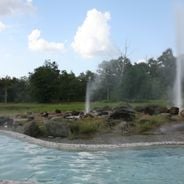
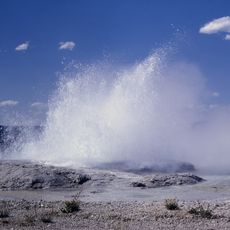
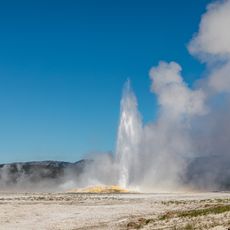
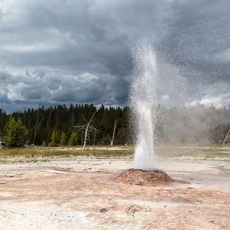
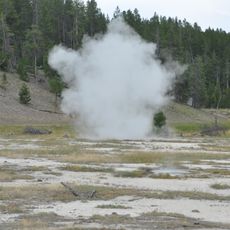
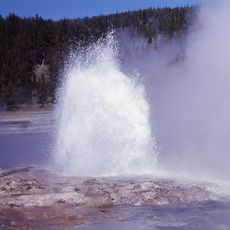
White Dome Geyser is a geyser in Yellowstone's Lower Geyser Basin featuring a distinctive cone-shaped mineral deposit that rises above the ground. Water shoots upward to approximately 30 feet (9 m) during eruptions lasting about 2 minutes, with steam and spray mixing together in the spray.
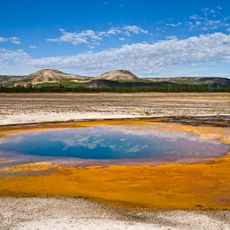
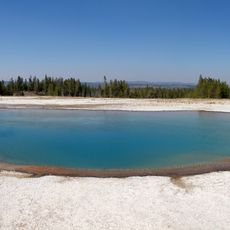
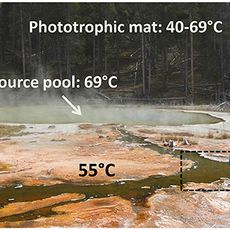
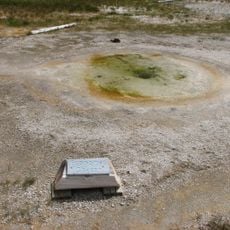
The cone grew over centuries as geyserite, dissolved in the water, was deposited around the vent; the German source notes this mineral is also called sinter. The Old Yellowstone Library and Museum Association, now the Yellowstone Association, long used White Dome Geyser in its logo. In 1969 researchers from Indiana University isolated the thermophilic bacterium Thermus aquaticus from Mushroom Pool, a non-erupting hot spring a few hundred feet away.
Scientists discovered Thermus aquaticus bacteria near White Dome Geyser, leading to advances in DNA research through polymerase chain reaction procedures.
The geyser can be reached from Firehole Lake Drive and erupts at unpredictable intervals ranging from minutes to hours. Visitors should be prepared to wait and remain flexible with their time, as eruption timing is not guaranteed and patience is essential.
The thermophilic bacterium Thermus aquaticus, whose enzyme made polymerase chain reaction possible, was first isolated in 1969 from Mushroom Pool, a non-erupting hot spring a few hundred feet from White Dome Geyser. The geyser's cone was long used as the emblem of the old Yellowstone Library and Museum Association, now the Yellowstone Association.
The community of curious travelers
AroundUs brings together thousands of curated places, local tips, and hidden gems, enriched daily by 93,725 contributors worldwide.