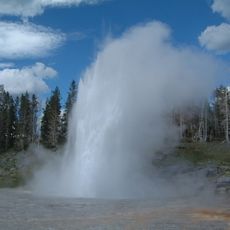
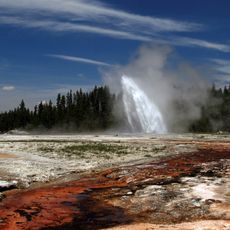
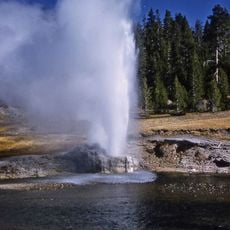
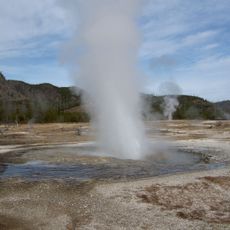
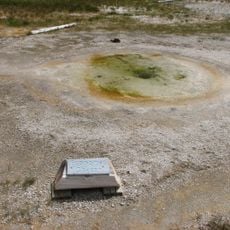
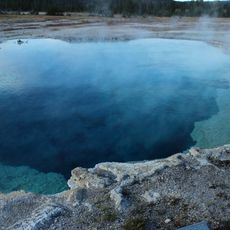
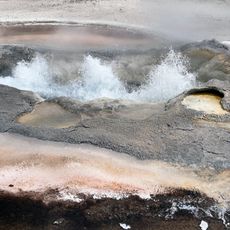
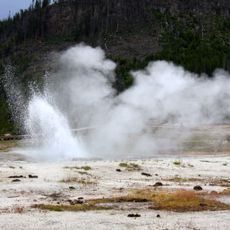
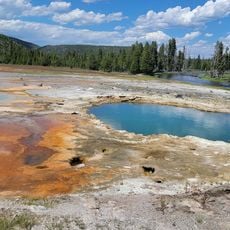
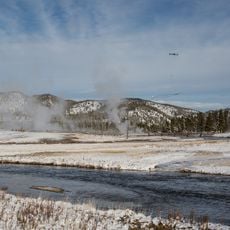
Artemisia Geyser, Geyser in Upper Geyser Basin, Yellowstone National Park, US.
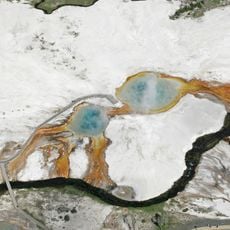
Artemisia Geyser is a fountain-type geyser in the Cascade Group of the Upper Geyser Basin, Yellowstone National Park. Its irregular pool, about 55 by 60 feet, holds turquoise-blue, highly transparent water. The surrounding sinter is pure white, except along the border and where submerged, where it takes on an olive-green tint. The pool rises and falls quietly, ruffled only by escaping gas bubbles.
Artemisia Geyser was named in 1883 by geologist Walter Weed after Artemisia tridentata, the big sagebrush common around Yellowstone, because the sinter on the crater's south and southwest sides matched the plant's colour. The Hayden Geological Survey of 1881 did not record it, and it was called only a spring until 1886.
The name comes from Artemisia tridentata, the big sagebrush common around Yellowstone, chosen in 1883 by geologist Walter Weed for the pale grey-green tint of the sinter on the crater's south and southwest sides. Arnold Hague described the pool's rim as pure white, turning olive-green where constantly submerged.
Activity here is unpredictable, with eruptions occurring at intervals ranging from a few hours to a couple of days apart. Access to this location is available via marked pathways in the park and requires no special equipment or preparation.
Eruptions are accompanied by a strong underground thumping caused by steam bubbles collapsing in the geyser's channels. The pool also overflows silently for hours before an eruption, with no visible warning until the overflow suddenly increases.
The community of curious travelers
AroundUs brings together thousands of curated places, local tips, and hidden gems, enriched daily by 93,501 contributors worldwide.