Dinosaur Park Formation, Geological formation in Alberta, Canada
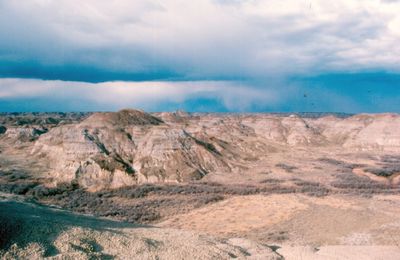
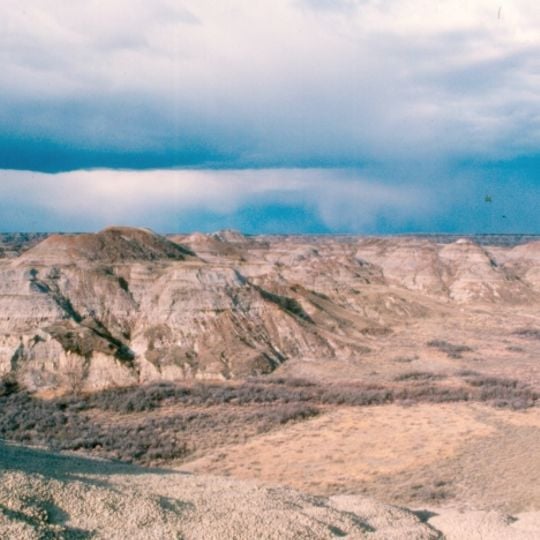
Dinosaur Park Formation is the uppermost member of the Belly River Group, about 70 metres thick at Dinosaur Provincial Park. Its lower part is fine- to medium-grained crossbedded sandstone laid down in river channels; the upper part is organic-rich mudstone with root traces and thin bentonite beds, capped by the Lethbridge Coal Zone. In the park's badlands it appears as pale beige and grey banded cliffs above eroded slopes and gullies.
The first fossil bones were shown to the priest Jean-Baptiste L'Heureux in 1871 by Blackfoot people, who called them the "grandfather of the buffalo"; his notes went unpublished. In 1884 Joseph Burr Tyrrell found a theropod skull that Henry Fairfield Osborn named Albertosaurus in 1905. Lawrence Lambe surveyed the Red Deer River beds from 1897 to 1901.
The formation takes its name from Dinosaur Provincial Park, a UNESCO World Heritage Site where the badlands along the Red Deer River expose it. The first fossil note came in 1871, when the priest Jean-Baptiste L'Heureux was shown bones called the "grandfather of the buffalo" by the Blackfoot Confederacy he lived with; his notes went unpublished. In 1884 Joseph Burr Tyrrell found a theropod skull that Henry Fairfield Osborn named Albertosaurus in 1905.
You can explore this formation through Dinosaur Provincial Park, which maintains walking paths and offers guided tours. Sturdy footwear is recommended, and it helps to check locally which areas are currently accessible.
The first fossil note here came in 1871, when priest Jean-Baptiste L'Heureux was shown bones the Blackfoot called the "grandfather of the buffalo"; he never published it. In 1884 Joseph Burr Tyrrell found a theropod skull that Henry Fairfield Osborn named Albertosaurus in 1905.
The community of curious travelers
AroundUs brings together thousands of curated places, local tips, and hidden gems, enriched daily by 93,455 contributors worldwide.