Tanzenberg Castle, Renaissance castle and school in Sankt Veit an der Glan, Austria.
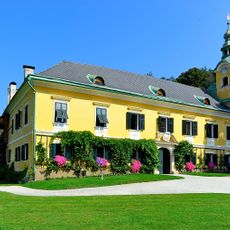
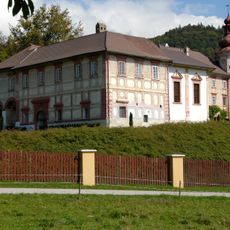
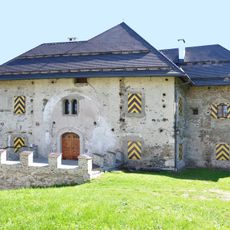
Tanzenberg Castle is a three-storey Renaissance complex of four wings around a rectangular courtyard, visible from afar above the Zollfeld. The ground and first floors largely keep 16th-century fabric, and the northeast wing retains parts of the medieval castle. Since 1898 the Olivetans' monastery church has stood on the southwestern side, replacing the former banqueting hall.
The castle was first mentioned in written records in 1247 and later came under the control of the Lords of Mordax. In the 16th century, it underwent major reconstruction into Renaissance architecture, shaping its appearance today.
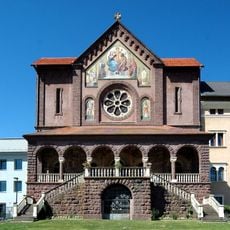
The castle church, built from 1906 to 1910 to plans by Hans Pascher, is a Neo-Romanesque basilica with three naves that was left unfinished until work resumed in 1980 and ended in 1987. On the facade, three mosaics by Josef Pfefferle from 1924–1927 show the Holy Family with Saints Benedict, Francisca, Florian and Bernard, plus the Archangel Michael and Saint Agnes. Inside, Valentin Oman painted the sanctuary walls in 1986–87 with scenes of human life.
The site functions mainly as a private school building under the Roman Catholic Diocese of Gurk, so visits may be restricted or available only by request. Visitors should check beforehand whether guided tours or special hours for the public are offered.
The castle's Renaissance well, probably finished by 1543 under Leonhard von Keutschach, no longer stands here: in 1802 it was moved to the main square of Friesach, where it serves as the town fountain. The school's alumni include Peter Handke, who later received the Nobel Prize in Literature.
The community of curious travelers
AroundUs brings together thousands of curated places, local tips, and hidden gems, enriched daily by 92,856 contributors worldwide.