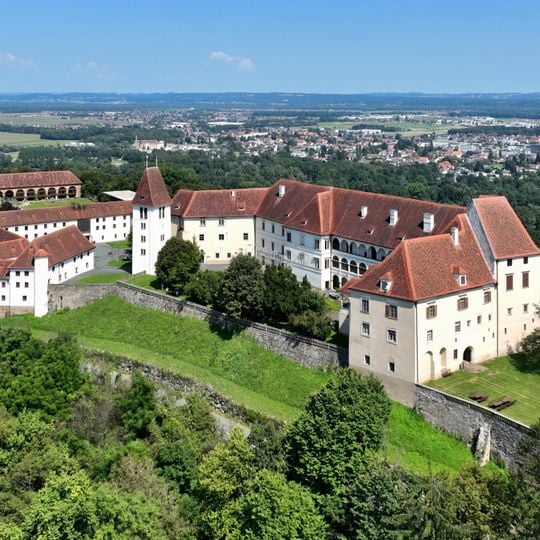
Schloss Seggau, Medieval castle in Leibnitz, Austria.
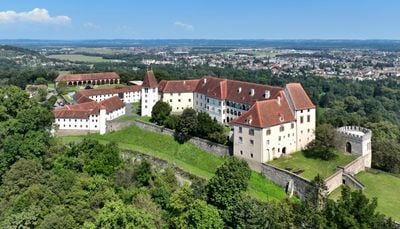
Schloss Seggau is a castle complex sitting on a wooded hill near Leibnitz in Styria, made up of several buildings from different periods arranged around inner courtyards. From its position, the grounds look out over the vineyards and gentle hills of southern Styria.
The upper castle was built by the Archbishops of Salzburg in the 12th century as a mission and administrative base for colonising southern Styria; from 1218 the bishops of Seckau expanded it. Three separate castles grew side by side: Burg Leibnitz of Salzburg, the Seckau bishops' castle and Schloss Polheim. In 1595 all three passed to the Bishopric of Seckau, and Bishop Martin Brenner joined the first two, removing the dividing wall. Bishop Johann Ernst Count of Thun gave the complex its present form in the later 17th century, with Antonio Solari building the arcades in 1664.
The site holds a lapidary with Roman stone objects found during excavations in the surrounding area, displayed in a dedicated room visitors can walk through. These carved stones and inscriptions show that this hilltop was already a known landmark in ancient times.
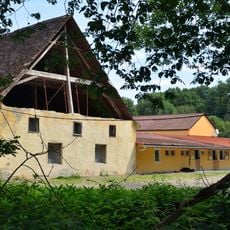
The complex is reached by road up the Seggauberg hill above Leibnitz; the Wirtschaftshof, converted into a Bildungshaus between 1955 and 1960, now holds the conference centre and hotel, with a modern annex for guest rooms and dining. The wine cellar lies beneath the 13-arch garden hall (Orangerie) at the far end of the castle garden. The free-standing clock tower between the Wirtschaftshof and the upper castle has a passage through to the castle courtyard.
The cellars beneath the complex are among the oldest still in use for wine production in Styria. The vines growing on the slopes around the hill belong to the castle estate, and the wine produced there can be tasted and bought on site.
The community of curious travelers
AroundUs brings together thousands of curated places, local tips, and hidden gems, enriched daily by 94,458 contributors worldwide.