Burg Wiener Neustadt, Renaissance castle in Wiener Neustadt, Austria
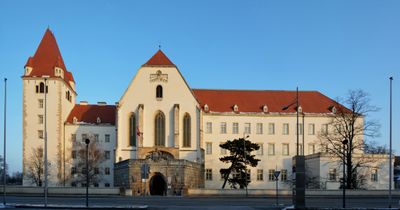
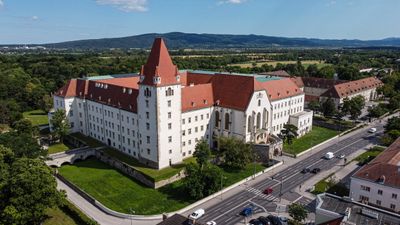
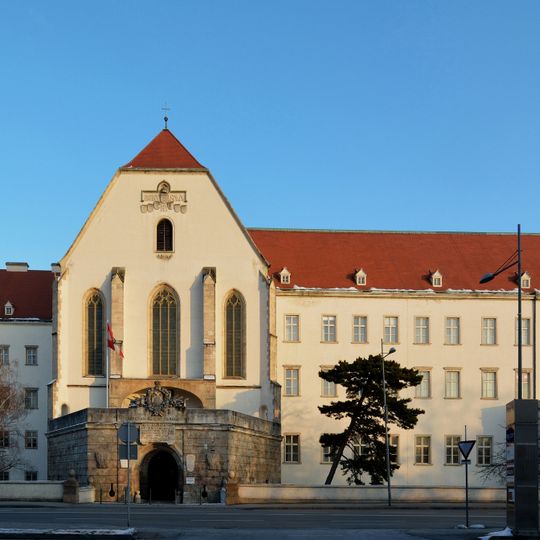
Burg Wiener Neustadt is a castle complex whose present buildings were rebuilt between 1946 and 1959 after wartime destruction, with the medieval ground walls kept where possible. A pale gabled section with pointed windows and a round window beneath a carved emblem stands above a rusticated stone gatehouse with a rounded archway. A white-plastered wing surrounds an inner courtyard, with a square tower capped by a steep pyramidal red roof and corner turrets.
The first castle was built in 1193–94 on the city's north-eastern corner, paid for with the ransom of Richard the Lionheart; no trace of it survives. A second castle rose on the present marshy site under Leopold VI in the early 13th century, on wooden piles, and was first documented in 1260. Earthquakes in 1348 and 1356 destroyed the Babenberg building, and Leopold III began a new one, whose chapel keystone is dated 1379. Frederick III made it his residence, and Maximilian I was buried in St. George's Chapel in 1519.
The castle church, built by Peter von Pusica between 1440 and 1460, began as the Marienkapelle and was renamed St. George's when Frederick III made it the seat of his Order of St. George. Emperor Maximilian I was buried beneath the high altar in 1519. Since 1987 it has served as cathedral for Austria's military bishop.
The site is home to a military academy that actively uses the fortress for officer training and education programs. Visitors should expect limited accessibility in some areas, as the ongoing military operations may restrict access to certain sections.
The letters A.E.I.O.U., linked to Frederick III, appear in several places in the castle, not only on the walls. The Rákóczi Tower, part of the complex, served as a state prison; Francis II Rákóczi and Count Peter Zrin were held there.
The community of curious travelers
AroundUs brings together thousands of curated places, local tips, and hidden gems, enriched daily by 94,052 contributors worldwide.