Zollamtsbrücke, Railway bridge in Innere Stadt, Vienna, Austria
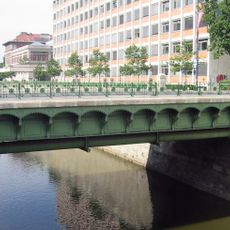
The Zollamtsbrücke is a 64.35-metre-long, 3.5-metre-high railway bridge that carries the U4 line diagonally over the Wien River between Landstraße and Innere Stadt, crossing at an angle of 30° 22′ to its abutments. Otto Wagner designed it for the Stadtbahn, and it stands just before the Wien flows into the Donaukanal near the Urania. Directly above it runs the separate Zollamtssteg, a footbridge for pedestrians and cyclists.
Otto Wagner designed this bridge in 1900 as part of the Stadtbahn, Vienna's ambitious transit project during the early modern period. The project reshaped the city's transport network and laid the foundation for Vienna's contemporary rail system.
The bridge is named after Vienna's Hauptzollamt, the main customs office that stood south of the Wien River. The name passed to the structure even though the office is gone. The Zollamtssteg, the pedestrian and cyclist bridge directly above it, is a separate structure and not part of the railway bridge.
The Zollamtsbrücke carries only the U4 tracks; pedestrians and cyclists cross the Wien River on the Zollamtssteg, the separate footbridge directly above it. That crossing links the Landstraße and Innere Stadt banks near the Urania, just before the Wien River meets the Donaukanal.
The Zollamtssteg is a separate footbridge and cycle crossing that runs directly above the Zollamtsbrücke, not alongside it. It is a distinct structure from the U4 railway bridge below, and the two are often confused. Pedestrians and cyclists use the upper deck to cross the Wien River near the Urania.
The community of curious travelers
AroundUs brings together thousands of curated places, local tips, and hidden gems, enriched daily by 92,796 contributors worldwide.