Monte Cavallino, Mountain summit in East Tyrol and Belluno, Austria and Italy
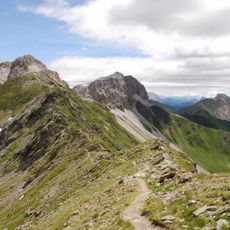
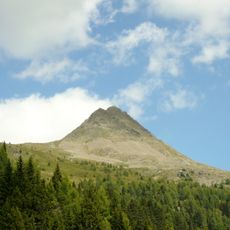
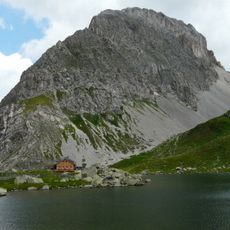
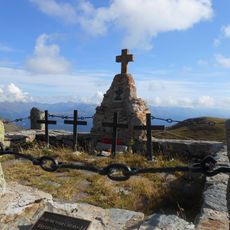
Monte Cavallino, called Große Kinigat in German, is a 2689 m summit on the main Carnic ridge along the Austrian-Italian border, rising above Kartitsch in East Tyrol and Comelico Superiore in the province of Belluno. It is the fourth-highest peak of that ridge, after the Hohe Warte, the Kellerspitzen and the Hochweißstein. A large cross, the Croce d'Europa, stands on the summit, and a horse carved by unknown hands in 1770 is cut into a wall of the Italian face.
Anton Victorin from Sillian and Peter Tassenbacher made the first recorded ascent on 21 July 1898, also climbing the nearby Königswand (2686 m) in the same outing. The summit was heavily contested in World War I, as Italian forces sought access to the Puster Valley. In July 1979 the Europa Cross was erected there, funded by the Kartitsch municipality and its rifle company together with citizens of Comelico Superiore.
On the Italian side a horse is carved into a rock face, made by unknown hands in 1770; the Italian name Monte Cavallino refers to it. German speakers call the peak Große Kinigat. Each year, usually on the last Sunday of August, mountaineers gather on the summit for the Kinigat mountain mass, which the bishops of Belluno and Innsbruck have attended.
The summit lies on the Austrian-Italian border above Kartitsch and Comelico Superiore. The European Cross stands on top, and a horse carved by unknown hands in 1770 marks a wall on the Italian side. The annual mountain mass is usually held on the last Sunday of August.
The northeast face drops as a 500-meter vertical wall with climbing routes graded up to UIAA VI+ difficulty. This steep face stands in sharp contrast to the more moderate normal route that many hikers can navigate.
The community of curious travelers
AroundUs brings together thousands of curated places, local tips, and hidden gems, enriched daily by 93,694 contributors worldwide.