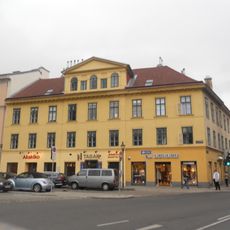
Altes Palmenhaus, Orangery at Schönbrunn Palace Park, Vienna, Austria
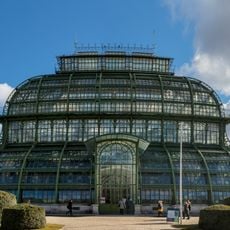
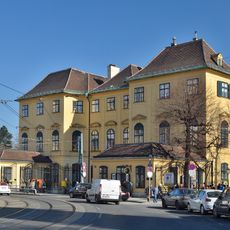
The Altes Palmenhaus is a three-part orangery building on Maxingstraße at the western edge of Schönbrunn Palace Park in Hietzing, built from 1820 for Emperor Franz I. Its long north-south structure has a glass facade facing east, restored after 2006. The southern part now holds the Schönbrunn Zoo's orangutans, the middle section is the visitor area behind large glass panes, and the north houses the Café "Atelier Nonja".
Emperor Franz I commissioned the three-part orangery building in 1820 (other sources give 1828 or 1836) on Maxingstraße, to house plants collected on a multi-year expedition to Brazil. It was extended in 1860, but lost importance after the new Palmenhaus opened in 1884. Two aviaries for exotic birds followed in 1889 and an administrative building in 1910, before the building was closed.
Since May 2009 the building has been called ORANG.erie, a pun on its past as an orangery and on the orangutans now kept in its southern wing. The northern section holds the Café "Atelier Nonja", named after a zoo orangutan whose paintings hang there; a library occupies the upper floor.
The visitor area lies in the middle section, separated from the orangutan enclosure by large glass panes; the southern part houses the animals, the northern part the Café "Atelier Nonja", and a library occupies the upper floor. A pedestrian passage beneath the Botanical Garden links the building with Schönbrunn Zoo. The Friends of the Zoo association holds evening lectures in the hall once a month.
Since May 2009 the southern wing has housed the zoo's orangutans, which inspired the name ORANG.erie, a pun on Orangerie. Their enclosure has ropes for swinging and an outdoor area with trees up to eleven metres high, viewed through large glass panes from the central visitor area.
The community of curious travelers
AroundUs brings together thousands of curated places, local tips, and hidden gems, enriched daily by 92,853 contributors worldwide.