Dachstein Formation, Limestone formation in Northern Alps, Austria
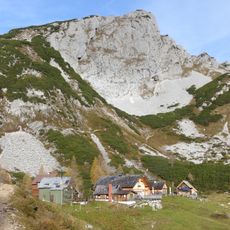
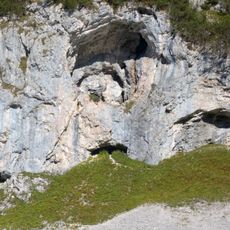
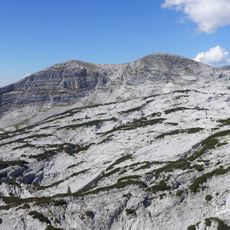
The Dachstein Formation is a Triassic carbonate sequence up to 1800 m thick, named after the Dachstein Massif in the Salzkammergut, its type locality, and first described by Friedrich Simony in the 19th century. It splits into well-bedded limestone, layered on a scale of metres to tens of metres, and a massive reef facies with ooids and reef debris. The bedding gives many cliff faces a stepped, banded profile visible from afar.
The formation developed during the late Triassic period, millions of years ago, when a shallow sea existed here. During this time, shells, skeletons and other remains of sea creatures accumulated and eventually compressed into stone.
The name comes from the Dachstein Massif, the type locality in the Salzkammergut, where Friedrich Simony first described the rock in the 19th century. The stepped banding of the bedded limestone, visible on large cliff faces, was named the Lofer cyclothem by Alfred G. Fischer after exposures in the Lofer Mountains.
The formation is a rock unit, not a site with marked trails or caves open to visitors; its type locality is the Dachstein Massif in the Salzkammergut. Good exposures of the bedded limestone occur in the Lofer Mountains, where Alfred G. Fischer first described the Lofer cyclothems. The layering is best seen on large cliff faces, where single beds stand out from a distance.
The bivalve Megalodus (often called Megalodon) can reach 20 cm across and is a commonly found fossil in the Dachstein Limestone. The Northern Limestone Alps exposures are a classic palaeontological study site for their exceptionally diverse Norian-Rhaetian reef biota, with more than 50 species identified in the reef framework alone.
The community of curious travelers
AroundUs brings together thousands of curated places, local tips, and hidden gems, enriched daily by 93,031 contributors worldwide.