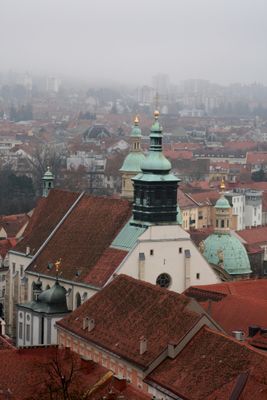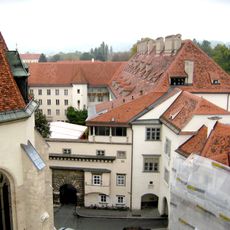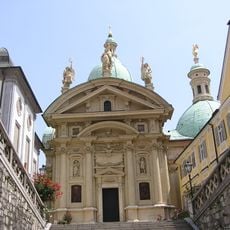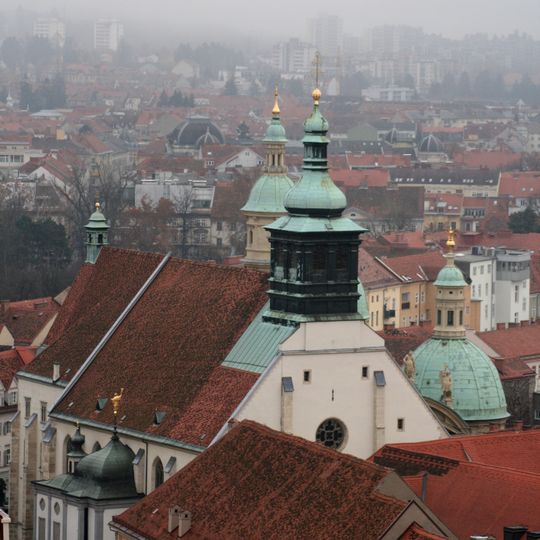
Graz Cathedral, Gothic cathedral in Innere Stadt, Graz, Austria.
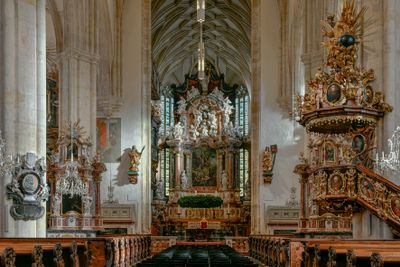
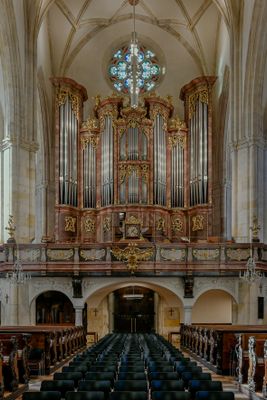
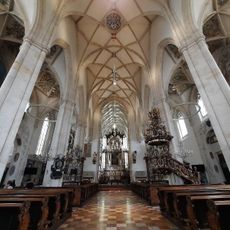
Graz Cathedral is a late-Gothic hall church of brick and limestone, with a broad nave flanked by two narrower aisles under one continuous roof, eight octagonal piers carrying the vaults, and a Baroque organ gallery at the rear. Its exterior is largely whitewashed, with the 1456 west portal as the most ornate feature. Inside, tall windows with clear glass and dark stone tracery light the nave, and the high altar of veined marble (1730–33) holds a painting of Saint Giles.
Emperor Frederick III ordered the complete rebuilding of a church dedicated to Saint Giles in 1438, alongside his new Graz Castle; the Gothic structure was largely finished by about 1464. In 1577 Archduke Charles II handed it to the Jesuits, who modified it in the Baroque style. In 1786, under Joseph II's reforms, it was elevated to cathedral status for the new Diocese of Graz-Seckau, with Joseph Adam Graf von Arco as first bishop.
The cathedral is dedicated to Saint Giles, patron saint of Graz, and its parish celebrates the anniversary of the dedication on 1 May, a date tied to a 1441 market charter of Emperor Frederick III. From 1577 to 1773 the Jesuits used the church, and their symbols remain carved on the 18th-century pulpit and choir stalls. Two ivory-inlaid bridal chests of Paola Gonzaga, reused by the Jesuits as reliquaries, stand at the chancel arch.
The building sits in the old town and is easy to reach on foot, with regular visiting hours during daytime. Visitors should know that the interior may be closed during religious ceremonies, so it helps to check ahead.
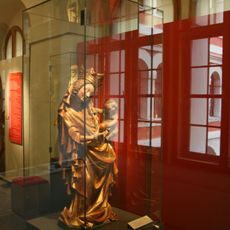
The two ivory-inlaid bridal chests of Paola Gonzaga, made for her wedding, were later reused by the Jesuits as reliquaries for martyrs and now stand on pedestals at the chancel arch. The 1457 Crucifixion panel by Conrad Laib of Salzburg, rediscovered in fragments, hangs in the cathedral.
The community of curious travelers
AroundUs brings together thousands of curated places, local tips, and hidden gems, enriched daily by 94,193 contributors worldwide.