Graz double spiral stairs, Double spiral staircase in Castle of Graz, Austria.
The Graz double spiral stairs is a stone structure within the castle's inner courtyard featuring two separate staircases that twist around a central axis. The spirals wind upward in opposite directions, intersecting only at landing platforms on each floor where they briefly meet before continuing their independent paths.
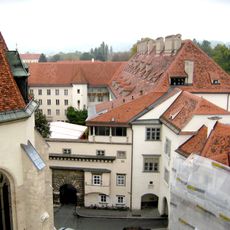
Built in 1499/1500 during the reign of Maximilian I, the staircase was carved from sandstone by stonemasons of a medieval building lodge under an unknown master builder. It received a stair tower visible from outside on the courtyard facade of the Karlsbau. In 1506 two Roman gravestones from nearby Flavia Solva were walled into the facades.
The staircase reflects a design philosophy where separated paths converge at each level, creating a visual metaphor for connection. Visitors can observe how the two spirals come together at landing points before diverging again as they continue upward.
The staircase stands in the courtyard of the Grazer Burg, entered from Hofgasse in the city centre. The two spirals are climbed as one route: each flight rises through the storeys and meets its twin only at the landings. The sandstone steps are worn smooth in places, so watch your footing on the hollow-spindle turns.
The two flights are carved from sandstone around hollow spindles, a construction bold enough that Konrad Wachsmann cited the Graz stairs as an influence on his 1953 Grapevine study in Chicago. Locals call them Busserlstiege, the kiss staircase, because the two spirals touch briefly on every floor before parting again.
The community of curious travelers
AroundUs brings together thousands of curated places, local tips, and hidden gems, enriched daily by 94,046 contributors worldwide.