Palais Coburg, Neoclassical palace in Innere Stadt, Vienna, Austria
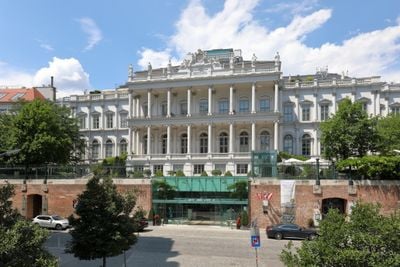
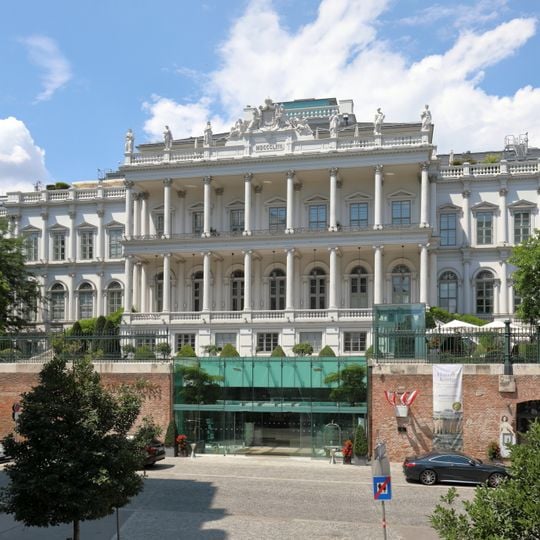
Palais Coburg is a late Neoclassical palace completed in 1845 on the Braunbastei, a remnant of Vienna's former city walls. Its white facade has a taller central section crowned by a balustrade with statues and the inscription "MDCCCLXIV", two tiers of columns above an arcaded lower level, and a modern glass-and-steel entrance with a green canopy at its base.
Ferdinand Georg August of Saxe-Coburg-Saalfeld-Koháry commissioned the palace; Karl Schleps designed it in 1839, and after Schleps died in 1840 Adolf Korompay completed it in 1845 on the Braunbastei, a remnant of Vienna's 16th- and 17th-century bastions. It stood empty until 1849, when August of Saxe-Coburg and Gotha and Clementine d'Orléans moved in and rented parts out. Bomb hits damaged it in 1945; Peter Pühringer bought it in 1997 and renovated it from 2000 to 2003.
The nickname Spargelburg ("asparagus castle") comes from the freestanding columns of the central facade. August of Saxe-Coburg and Gotha and his wife Clementine d'Orléans, who moved in in 1849, had the state rooms of the first upper floor fitted with the insignia of the French royal house and of the House of Saxe-Coburg and Gotha. Parts of the palace were rented out as flats.
The building operates today as a luxury hotel with a small number of rooms and sits in a central location with good connections to Viennese attractions and transportation. Visitors can use the location to explore the historic center easily and reach the main sights from here.
The building hosted a major international agreement in 2015 that shaped world politics. This shows how the historic site continues to serve as a venue for important negotiations between nations.
The community of curious travelers
AroundUs brings together thousands of curated places, local tips, and hidden gems, enriched daily by 92,947 contributors worldwide.