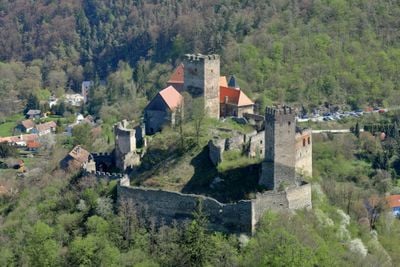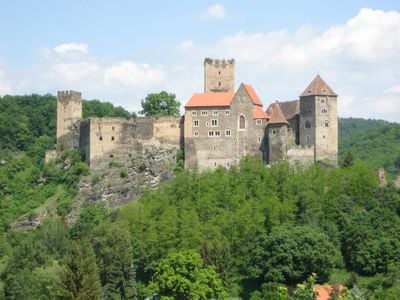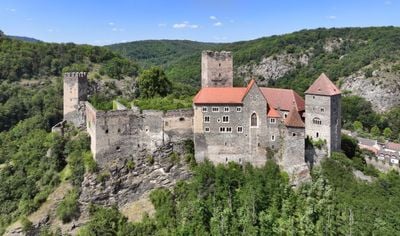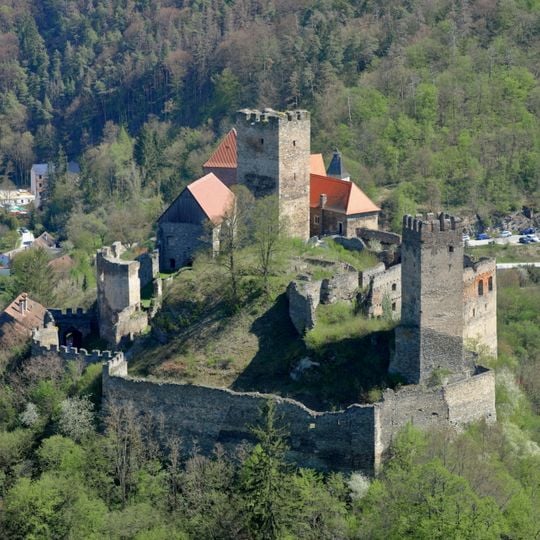
Hardegg Castle, Medieval castle and museum in Hardegg, Austria.
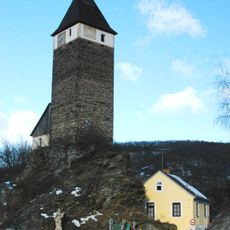
Hardegg Castle stands on a rocky hilltop at 317 meters (1,040 feet) elevation with stone walls, towers, and gates overlooking the Thaya River valley. Multiple sections including the knight's hall, winter kitchen, smithy, chapel, and keep are accessible to explore through the structure.
Hardegg was first mentioned in 1145 in a charter of Elisabeth von Schleunz, where Otto de Hardeck appears as a witness; a small fortification already stood before that. The counts of Plain and Hardegg were the first owners, and under later lords the castle was enlarged with a tower, a hall and a chapel until it ranked among the largest in the country. In 1499 it passed to the Habsburgs, who handed it to the Prüschenk brothers, and from the mid-17th century it belonged to the Khevenhüller family. After a fire in Hardegg in 1764 residents were allowed to take its stone and wood, and from 1878 Johann-Carl von Khevenhüller had it rebuilt.
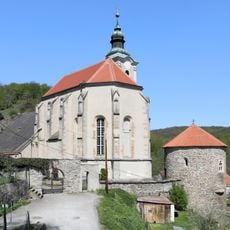
The castle's name comes from Old High German hard (forest) and egg (rock), meaning a fortified house in the woods. Johann-Carl von Khevenhüller, who fought alongside Emperor Maximilian in Mexico, set up a museum honouring the emperor and had a family crypt built beneath the castle chapel.
The castle is closed to the public: after a controversy over a painting it was shut and is now inaccessible to visitors. It stands high above the Thaya valley, dominating the small town of Hardegg that grew below it. The complex can therefore only be viewed from outside, from the town and the surrounding wooded slopes.
The castle's name comes from Old High German: hard, meaning forest, and -egg, meaning rock, giving "a firm house in the forest". The castle is now closed to visitors after a controversy over a painting shown in its dining hall during the 2013 Czech presidential election.
The community of curious travelers
AroundUs brings together thousands of curated places, local tips, and hidden gems, enriched daily by 92,892 contributors worldwide.