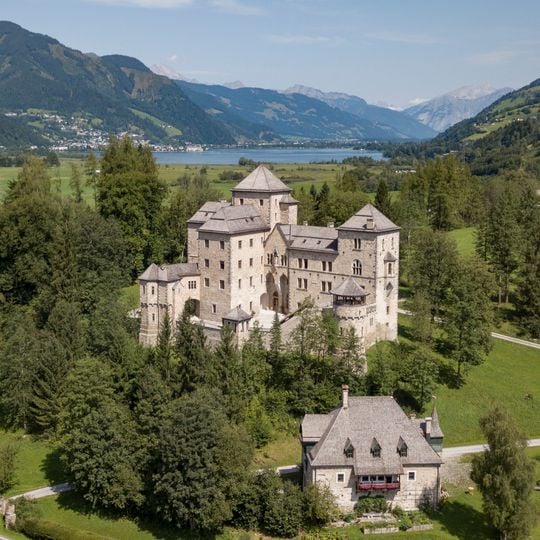
Schloss Fischhorn, Medieval château in Bruck an der Großglocknerstraße, Austria
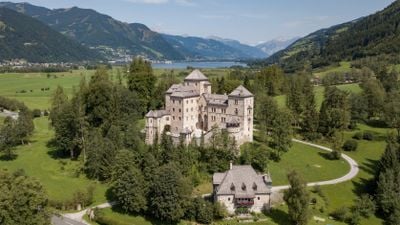
Schloss Fischhorn is a light gray stone castle of connected wings and towers above green trees, its tallest central bergfried topped by a steep pyramidal roof. A square tower with a similar roof stands to the right, with a small round turret at its corner, and a lower square tower on the left. A pointed-arch entrance with steps faces south; the walls are pierced by small rectangular windows.
A first fortified building probably stood here around 1200; the castle was first documented in 1227 as Vischarn. From 1273 the Bishops of Chiemsee are confirmed as owners, using it as a residence and administrative seat. In 1526 rebellious peasants plundered and burned the castle, and a 1602 report describes collapsed walls and dilapidated roofs. Bishop Johann Franz von Preysing ordered repairs only in 1675.
The coats of arms of the Löwenstein and Liechtenstein families still hang above the castle gate, recalling the buyers who commissioned the Neo-Gothic rebuilding. From 2007 the owners have occasionally opened parts of the residence for exhibitions and concerts, and part of the complex serves as a hotel.
The castle is privately owned and does not permit public access to its interior spaces. However, visitors can view the exterior from nearby locations and appreciate its architectural features from different angles.
From September 1944 the castle was one of 169 subcamps of Dachau, holding 150 prisoners, mostly captured Soviet officers; the SS had taken over the building in May 1943 and also stored Adolf Hitler's private letters there. In early May 1945 Hermann Göring was held at Fischhorn for three days before being moved to Kitzbühel.
The community of curious travelers
AroundUs brings together thousands of curated places, local tips, and hidden gems, enriched daily by 94,257 contributors worldwide.