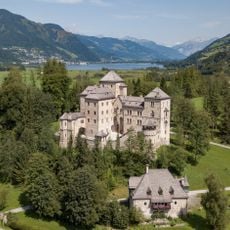
Kaprun Castle, Medieval fortress in Kaprun, Austria
Kaprun Castle is a castle ruin on a hilltop above the town of Kaprun in the Austrian state of Salzburg. The surviving stone walls, towers, and interior rooms show how a medieval fortified complex was arranged across its different levels.
Kaprun Castle dates from the 12th century and was first documented in 1280 as Turm zu Chaprunne. In 1526 it was set on fire and burned down during the Salzburg Peasants' War. Between 1580 and 1600 the Salzburg steward Josef Hundt von Ainetperg rebuilt it in its present ground plan. In 1606 Archbishop Wolf Dietrich von Raitenau had the Kaprun steward Caspar Vogl beheaded.
The name of the castle comes from the town of Kaprun that sits just below it. Today the site hosts concerts and theater performances inside the old walls, giving the ruins a second life as a gathering place for locals and visitors alike.
The ruin sits on a hill and is reached by a footpath where solid shoes are a good idea since the ground is uneven in places. Guided tours run regularly in summer, though the site can also be visited outside that season.
The castle's name first appears in a document of 9 February 931 as the Celtic Chataprunnin, meaning "wild water", in the Codex Odalberti. The building itself is not recorded until 1280, when it is called Turm zu Chaprunne in connection with raids by the Felber family. The site was sold in 1921 by Prince Johann II of Liechtenstein to the Peruvian envoy Heinrich E. Gildemeister.
The community of curious travelers
AroundUs brings together thousands of curated places, local tips, and hidden gems, enriched daily by 93,551 contributors worldwide.