Burg Deutschlandsberg, Medieval castle and museum in Deutschlandsberg, Austria
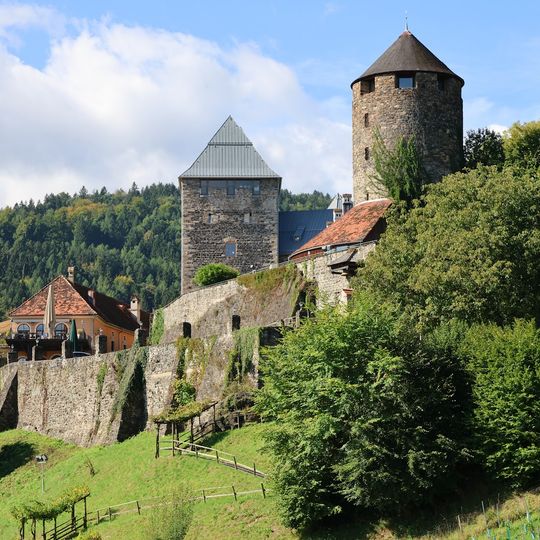
Burg Deutschlandsberg is a castle in Deutschlandsberg, Austria, that now functions as a museum spread across eight exhibition spaces. The complex includes a medieval defensive tower and former residential buildings where regional archaeological items from different periods are displayed.
Settlement traces on the Tanzplatz plateau go back to the Neolithic Lasinja culture (c. 3900–3300 BC), with later Hallstatt and La Tène finds. Around 970 Emperor Otto I gave the area to the Archbishopric of Salzburg, which built a stone main tower in the first half of the 12th century and enfeoffed the Lonsberger ministerials; a Fridericus de Lonsberch is documented as burgrave in 1153. The castle appears as castrum Lonsperch in charters of 1185 and 1188, and in 1292 the Landsberger Bund was concluded here.
The castle's name comes from the Lonsberg ministeriales, a Salzburg service family documented with a burgrave Fridericus de Lonsberch in 1153, the same year a chapel dedicated to St. Lawrence was installed. A chapel rebuilt under Hans Jacob von Kuenburg between 1597 and 1607 was consecrated to St. Rupert, Salzburg's patron. In the medieval part a Rittersaal retained ceiling painting of a Thirty Years' War battle into the early 19th century.
The castle stands on a rock spur at 511 m above sea level above the Laßnitz valley, reached on foot from Deutschlandsberg below. The grounds are a protected monument, so paths and the medieval tower area are best explored on foot; the terrain is uneven and climbs.
The 2015 and 2016 excavations on the castle hill recovered 47,940 pottery fragments, including 4,756 rim and 2,634 base pieces, plus thousands of animal bones. The oldest finds come from the Tanzplatz, a flat spot northeast of the castle, with Neolithic Lasinja culture material dated roughly 3900–3300 BC.
The community of curious travelers
AroundUs brings together thousands of curated places, local tips, and hidden gems, enriched daily by 92,817 contributors worldwide.