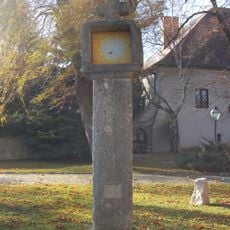
Einhornhöhle, Show cave and natural monument in the Hohe Wand Nature Park near Dreistetten, Lower Austria, Austria.
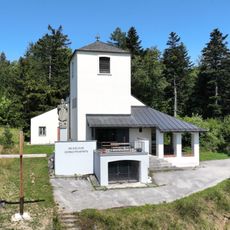
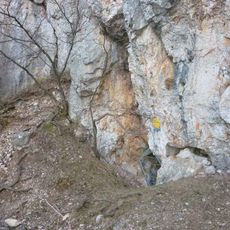
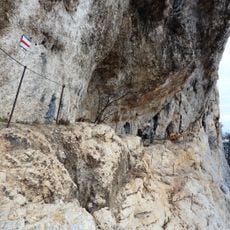
The Einhornhöhle is a show cave in the Hohe Wand Nature Park near Dreistetten, reached via an artificial gallery entered through a hut. Inside, a side tunnel leads to the main corridor and a hall with stalagmites about one metre high; a passage shows a calc-sinter curtain, stalactites and, in a niche with a statue of St. Barbara, pearl sinter.
The cave was discovered in 1927 by Otto Langer senior and opened as a show cave in 1930. During the Second World War it served as a shelter, and it reopened to visitors in 1958. In 1964 the installations built by Otto Langer junior were modernised. Pleistocene animal bones, mainly cave bear, were found inside, along with Bronze Age and Hallstatt-period finds.
The cave's name, Einhornhöhle (Unicorn Cave), also appears as Hirnflitzsteinhöhle and Oakirnlucke. Inside, a niche beside the passage holds a statue of St. Barbara, patron saint of miners, and the tour passes a calc-sinter curtain and stalactites. Bones of Pleistocene cave bears and finds from the Bronze and Hallstatt periods were unearthed here.
Access to the cave is only through guided tours offered on a regular schedule. Wear sturdy shoes since the pathways are sometimes uneven and can be slippery in places.
The cave has yielded many Pleistocene animal bones, mainly cave bear, and some teeth and bones remain visible in the rock layers; Bronze Age and Hallstatt-period finds were also made. A statue of St. Barbara, patron saint of miners, stands in a side niche where pearl sinter forms.
The community of curious travelers
AroundUs brings together thousands of curated places, local tips, and hidden gems, enriched daily by 92,793 contributors worldwide.