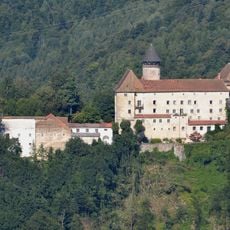
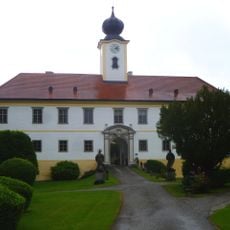
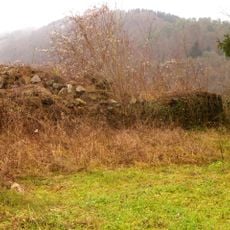
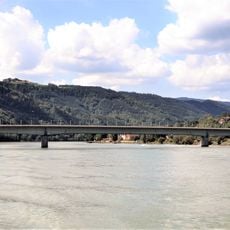
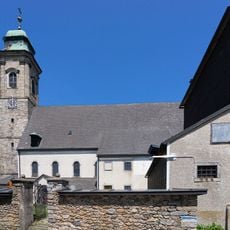
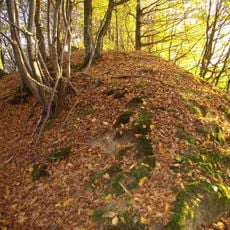
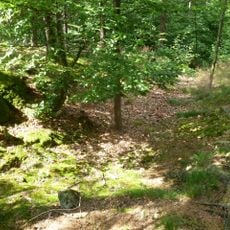
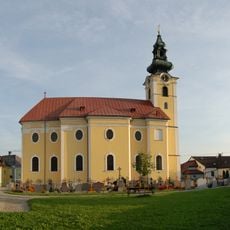
Burg Falkenstein an der Ranna, Castle ruin in Hofkirchen im Mühlkreis, Austria.
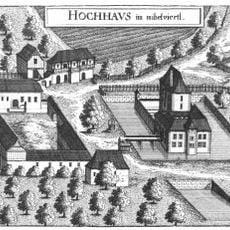
Burg Falkenstein an der Ranna is a ruined hilltop castle on a rock spur above the Ranna valley at 490 m. Its built area covered 2,960 m². The keep stood on the westernmost rock slab, followed by the main castle with the palas and two towers; a later outer bailey with a gate lay to the east, reached by a bridge over a 25–30 m wide neck ditch.
First mentioned in 1140, Falkenstein was held by the Falkenstein family, whose Kalhoch founded Schlägl Abbey in 1218. Through Perchta's marriage it passed to the Witigonen; her son Zawisch von Falkenstein fled here in 1277 after rebelling against Ottokar II. After Zawisch's execution in 1290, Duke Albert I starved the garrison into surrender. A 1572 fire damaged the castle, and after 1605 it was abandoned.
The Falkenstein family gave the castle its name; Adelram de Valchenstain is the first recorded member in 1140. Kalhoch von Falkenstein founded Schlägl Abbey in 1218, and the village name Kollerschlag recalls his land clearing. A legend tells of the water nymph Lilofee, who vanished after her husband Othmar spied on her in the water tower.
From Hofkirchen im Mühlkreis, drive toward Altenhof and follow the signposted path at the Meierhof farm; after 100 m the castle site of Peilenstein lies to the left. The ruin stands on a rock ridge 490 m above sea level, about 2.3 km from Hofkirchen and 2.2 km from where the Ranna meets the Danube. The site is not yet fully walkable; efforts to secure the ruin and reopen it to visitors are ongoing.
The round water tower, built in 1489 under the Oberhaimer lords, stands about 80 m opposite the main entrance and is roughly 17 m high. Its entrance lies 4.5 m above ground, and inside it held a well whose underground pipe fed the castle. A legend links it to the water nymph Lilofee.
The community of curious travelers
AroundUs brings together thousands of curated places, local tips, and hidden gems, enriched daily by 94,151 contributors worldwide.