Hirlatzhöhle, Natural monument cave in Hallstatt, Austria.
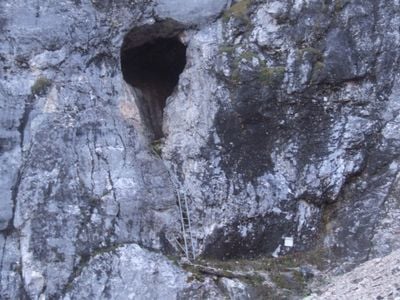
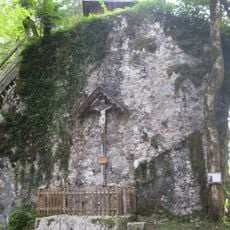
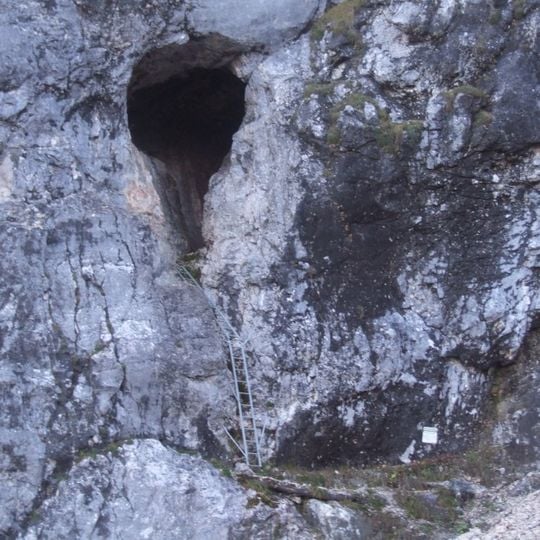
The Hirlatzhöhle is a cave in the Dachstein massif above Hallstatt, with a known length of over 120 km and a vertical range of 1560 m, from 2003 m down to 443 m above sea level. Its main entrance is a triangular opening in a fractured grey rock face, reached by a metal ladder; a small sign is fixed to the stone beside it. The cave has six entrances, three of them usable only by divers.
On 28 December 2011 the cave diver Gerhard Wimmer linked the Obere Brandgrabenhöhle (registry no. 1546/6) to the Hirlatzhöhle, pushing the surveyed length past 100 km at 100,068 m, with a known depth of 1,073 m at that time. Between 2007 and 2018 British explorers surveyed the What u Got Pot shaft to 7,191 m, and on 6 September 2018 a through-trip 830 m below its entrance connected it to the Hirlatzhöhle. Exploration, coordinated by the Hallstatt-Obertraun cave association, continues.
The cave lies in the core zone of the UNESCO World Heritage Cultural Landscape Hallstatt–Dachstein/Salzkammergut (WHS 806) and in the Dachstein European and nature reserve. In 1971 it was declared a natural monument (nd600) by Upper Austria, for Hallstatt and Obertraun. Exploration is coordinated by the Verein für Höhlenkunde Hallstatt-Obertraun, and the cave is locked all year.
Access requires special permission since the entrance remains locked year-round for protection. Visitors must contact the local caving association well in advance to arrange any visit.
In January 2005 Ulrich Meyer dived through two siphons in the eastern part of the cave, 11,500 m from the entrance — the greatest distance from an entrance at which a cave dive had been made. The cave's deepest point lies at 443 m above sea level, 65 m below the surface of the Hallstättersee.
The community of curious travelers
AroundUs brings together thousands of curated places, local tips, and hidden gems, enriched daily by 93,695 contributors worldwide.