Saint Jean church Feldkirch, Medieval church in Feldkirch, Austria
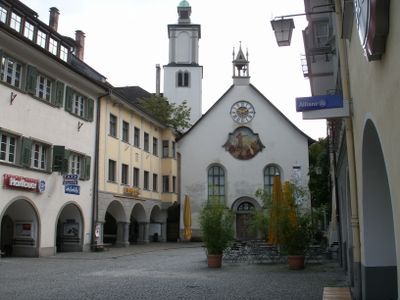
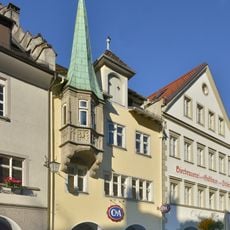
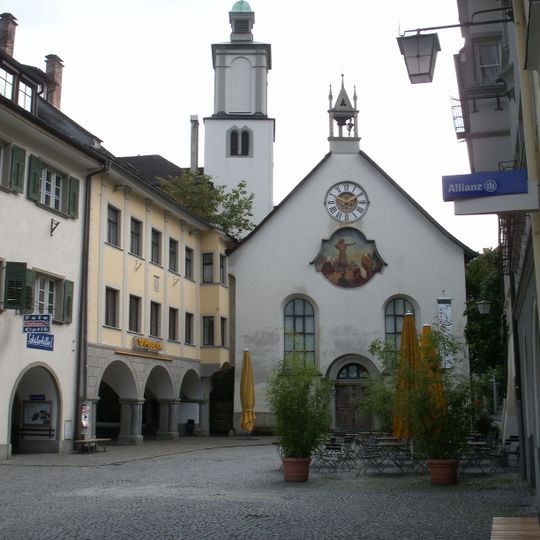
The Johanniterkirche stands on the southeast side of the Marktgasse in Feldkirch, its gable front facing the street and its nave and recessed three-sided choir running along the Johannitergasse. The tower sits in the eastern choir corner and is structurally joined to the former Gymnasium built in 1860. The core of the present building dates from the 15th and 16th centuries, with a saddleback roof toward the Marktgasse and a hipped-gable roof on the town side. Inside, the ceiling bears a painted round medallion, the Sigillum refugii with a swearing hand and the year 1405.
In 1218 Count Hugo von Montfort gave the Knights Hospitaller a hospice on Marktgasse, where a Romanesque church was built. The order sold the hospice to Weingarten Abbey, leaving only the church, which was remodelled in 1660 under prior Gabriel Bucelin and passed to Ottobeuren Abbey in 1695. It was destroyed in March 1799 during the Napoleonic Wars, then served as a horse stable and salt store before passing to the Gymnasium in 1809.
The church is no longer used for worship; since 1995 it has served as the town's exhibition centre for contemporary art, hosting four shows a year, two by local and two by international artists, curated by Eva Jakob. The name recalls the Knights of St John, who ran a hospice on Marktgasse from 1218. Look for the fresco of St John the Baptist painted by Florus Scheel on the gable facade in 1927.
The church stands on the southeast side of Marktgasse, with its gable front facing the street and the nave running along Johannitergasse; the tower is attached to the former Gymnasium building of 1860. It is now an exhibition space for contemporary art rather than a place of worship, so visits depend on the exhibition programme. The floor was opened for archaeological digs between 1983 and 1986 and left open, revealing six floor levels and 25 graves.
The tower holds a knight figure called "Bläsi" that has struck a bell to mark the time since 1510. The church floor was opened for archaeological digs from November 1983 to November 1986 and left open, revealing six floor levels and 25 graves.
The community of curious travelers
AroundUs brings together thousands of curated places, local tips, and hidden gems, enriched daily by 94,602 contributors worldwide.