Schloss Rosenhof, Castle in Sandl, Austria
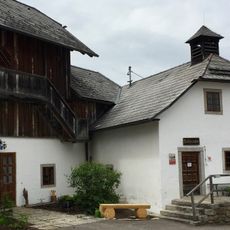
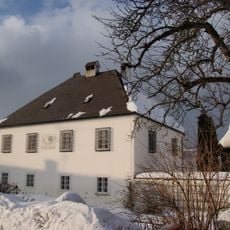
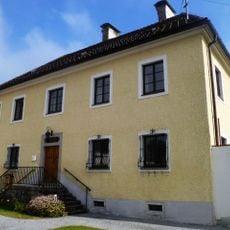
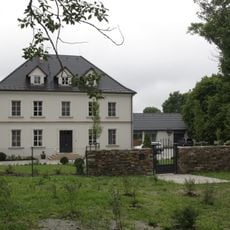
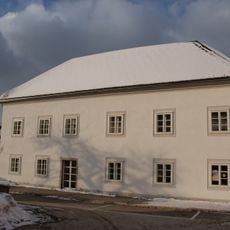
Schloss Rosenhof is a two-storey, horseshoe-shaped castle built in 1760 as a hunting lodge, standing in an extensive park two kilometres east of Sandl in the Mühlviertel, near the Czech border. Its central section has a broken mansard roof, the two side wings are covered with hipped roofs, and the entrance gate is flanked by columns in a three-axis central riser. The garden side bears the Kinsky coat of arms.
Count Alois Thomas Raymond Harrach built the hunting lodge in 1760; it passed in 1773 to Count Ferdinand Bonaventura von Harrach, who named it Rosenhof after his wife and daughter Rosa. An east wing followed between 1780 and 1792, and Count Franz de Paula Josef Kinsky added the west wing in 1827, giving the castle its present form. The Kinsky estate administration moved here from Harrachsthal in 1876.
The name Rosenhof comes from Count Ferdinand Bonaventura von Harrach's wife and daughter, both named Rosa. Under the Harrachs the estate became a model farm growing flax, potatoes, cabbage and turnips and raising livestock. The Kinsky family, who inherited it through Rosa's 1777 marriage, still owns the castle, now home to the Czernin-Kinsky family.
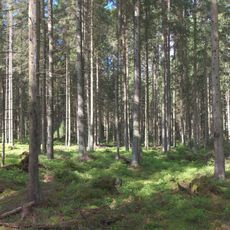
Schloss Rosenhof is a private residence of the Czernin-Kinsky family and is not open to visitors; the castle and its Ehrenhof can only be viewed from outside. The lower Rosenhofer Teich, part of the estate, is a popular public bathing pond. The B 38 Bohemian Forest Road runs in sections through the estate's forest.
The two Rosenhofer Teiche ponds were created to supply water for timber floating on the Aist; every spring logs were driven down the Flammbach, Schwarze Aist and Waldaist to Au an der Donau, bound into rafts and floated to Vienna. The practice ended in 1947. The smaller lower pond is now a public swimming pond.
The community of curious travelers
AroundUs brings together thousands of curated places, local tips, and hidden gems, enriched daily by 92,859 contributors worldwide.