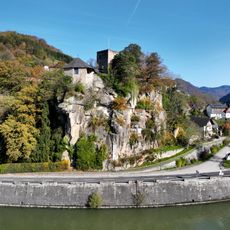
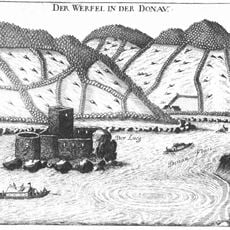
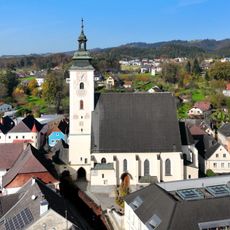
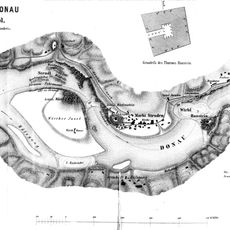
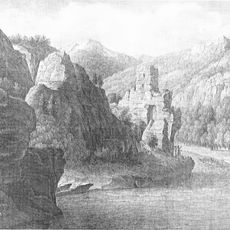
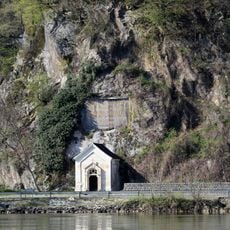
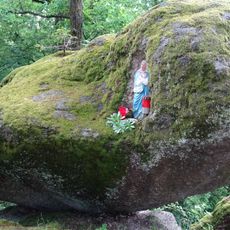
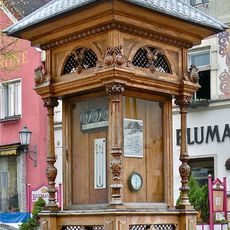
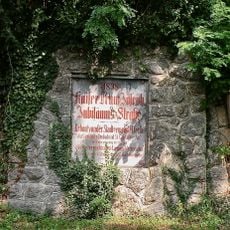
Stillensteinklamm, Narrow canyon in Grein and Sankt Nikola an der Donau, Austria.
Stillensteinklamm is a narrow canyon between Grein and Sankt Nikola an der Donau, where rock walls rise sharply on both sides. Water erosion over thousands of years has carved intricate formations through the stone that define the landscape.
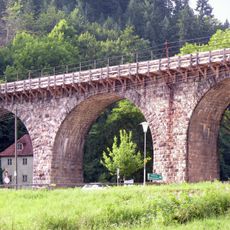
In 1834–1836, rock blasting made the Gießenbach usable for log floating (Scheiterschwemme); around 12,000 Klafter of wood were transported over the following ten years. From about 1880, paths, bridges and stairways opened the gorge to hikers, though floods destroyed them in 1915, 2002 and 2005. Since 1909 the Donauuferbahn crosses the Gießenbach valley near the Gießenbachmühle on a seven-arch viaduct, the highest railway viaduct between Sankt Valentin and Vienna and a listed monument.
The name Stillensteinklamm comes from the Gießenbach disappearing underground, making it silent. Since 2010 the gorge has been part of the Donausteig stage from Grein to Sarmingstein and the Donaurunde Burg Werfenstein. The entrance at the Gießenbachmühle lies on the Danube Cycle Path.
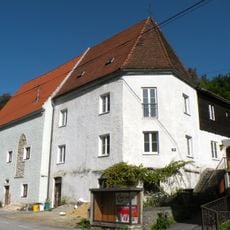
The entrance at the Gießenbachmühle, where the Gießenbach meets the Danube, sits on the Donauradweg; from 2010 the trail forms part of the Donausteig stage from Grein to Sarmingstein. The cave section may not be entered during thunderstorms or rain, or while the power plant above it is being regulated. The route climbs from 230 m at the mill to 405 m at the Aumühle.
The gorge takes its name from the Gießenbach disappearing underground, leaving the streambed silent. One cave it flows through is up to eight metres high, walkable for more than a hundred metres and has two entrances. The cave must not be entered during thunderstorms or rain, or while the power plant above it is being regulated.
The community of curious travelers
AroundUs brings together thousands of curated places, local tips, and hidden gems, enriched daily by 92,714 contributors worldwide.